Is 8 Hours of Sleep Really Needed? What the Research Says

If you regularly worry about whether you are getting enough sleep, this is for you.
We have been told for years that we need eight hours of sleep every night — that if we get it, great, and if we do not, it is a major problem that will cause major problems down the line. This focus on eight hours has probably increased insomnia, maybe even population-wide.
If you regularly worry about whether you are getting enough sleep, this is for you. You will come away understanding why that phrase is a myth — and yes, I back this up with scientific research. You will also understand why worrying about it is not helping at all, is not necessary, and is probably making the problem worse.
Where the Eight-Hour Number Comes From
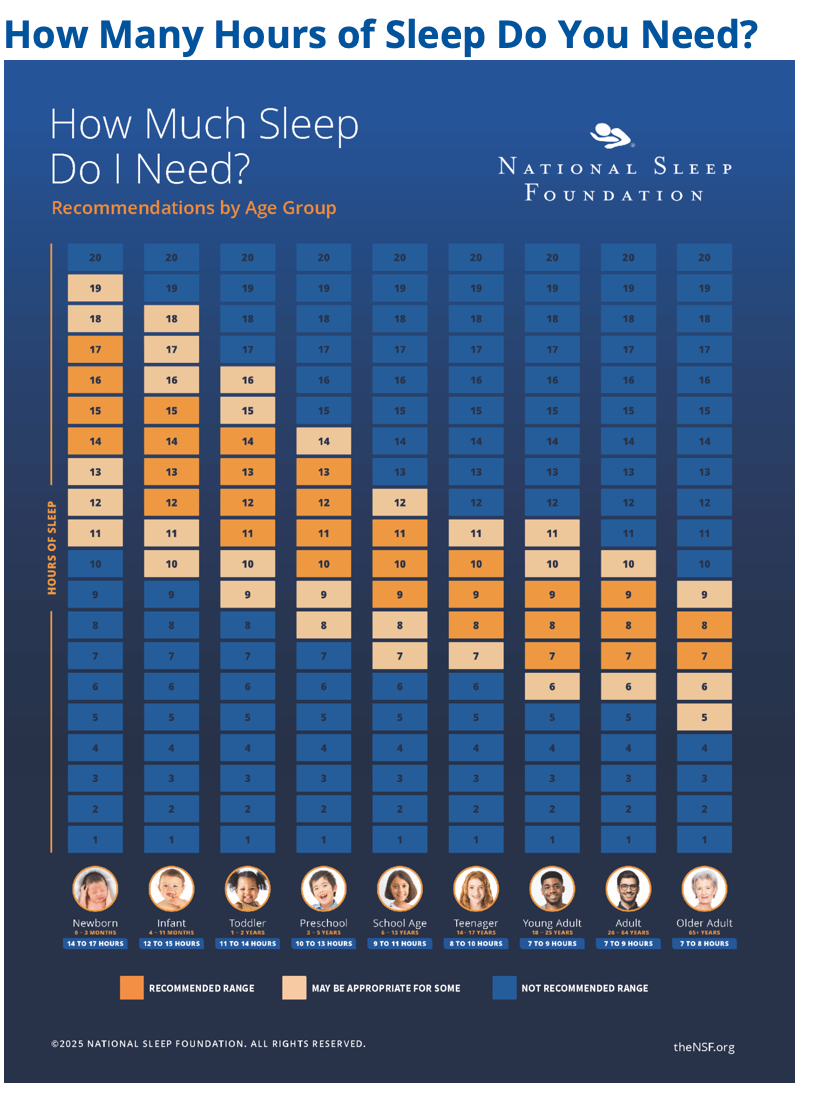
Let's start with where that eight-hour figure comes from. Look at the chart from the National Sleep Foundation on the amount of sleep recommended over the course of a lifetime.
It is no surprise that this changes over time, and that babies need far more sleep than older adults. But notice that the range of recommended sleep also narrows over time. For babies, the recommendation is 14 to 17 hours — a 3-hour range, depending on the individual. For adults, it is 7 to 9 hours, a 2-hour range. For older adults, it is actually 7 to 8, only a 1-hour range.
But people looking at this chart also tend to ignore the range above and below the recommended band, which is labeled “may be appropriate.”
For an adult — which this chart defines as someone between the ages of 26 and 64 — it might be appropriate for them to sleep 6 to 7 hours, or 9 to 10 hours. This is highly individualized. None of us need the exact same number of calories to maintain a steady weight. We do not need the exact same amount of sleep, either.
You might be thinking, “Yes, but I get less than six hours,” and I totally understand! I will come back to that and I do offer some practical tips at the end, as usual.
What the Research Actually Shows
There have been a lot of double-blind, research-based studies looking at the impact of a lack of sleep on health outcomes. There is certainly a link, but it resembles a U-shaped curve: for almost all of the negative health outcomes, too much sleep can be just as much of a problem. The optimal point in much of the research is actually seven hours, not eight. Again, this might not make a big difference to you if you get a lot less than that — but stay with me for a minute.
Most of the research documenting health risks from a lack of sleep uses five hours per night as the baseline, and it is five hours on a regular, ongoing basis. The documented health risks are about habitual sleep patterns — patterns sustained continuously over years, maybe even decades.
Short-term sleep loss is something most people experience at some point. It is very common. Take a particularly stressful period in your life: something happens, and you do not sleep much for a couple of months. Yes, that will have physiological effects. It will not be pleasant, but its effects are reversible. Longitudinal studies — studies conducted over long periods of time — show that when short sleep patterns resolve, and the amount of sleep increases, the associated long-term health risks disappear.
The Impact of Anxiety
Here is the other thing worth noting in the research: most, or many, studies control for anxiety and depression. That is meant to rule out anxiety and depression as the cause of the long-term health problems, leaving sleep as the culprit.
However, when I dug further into it — asking more questions and pulling up more articles — I found that most research studies focus on depression, or on depression and anxiety together. They rarely focus on anxiety alone. Given that anxiety raises cortisol, and that sustained anxiety can keep cortisol elevated — which is connected to health risks — it seems logical to me that we should be studying anxiety as the cause, rather than sleep duration.
If you have anxiety, you might be thinking, “Okay, Barbara, how is this helping? It's just giving me something else to worry about.” But the anxiety cycle that makes you worry about your sleep duration is making your anxiety worse — which makes the whole problem worse. The real thing to solve is the anxiety disorder itself. Adding a worry about sleep duration on top of it does not help.
Two Studies Worth Knowing About
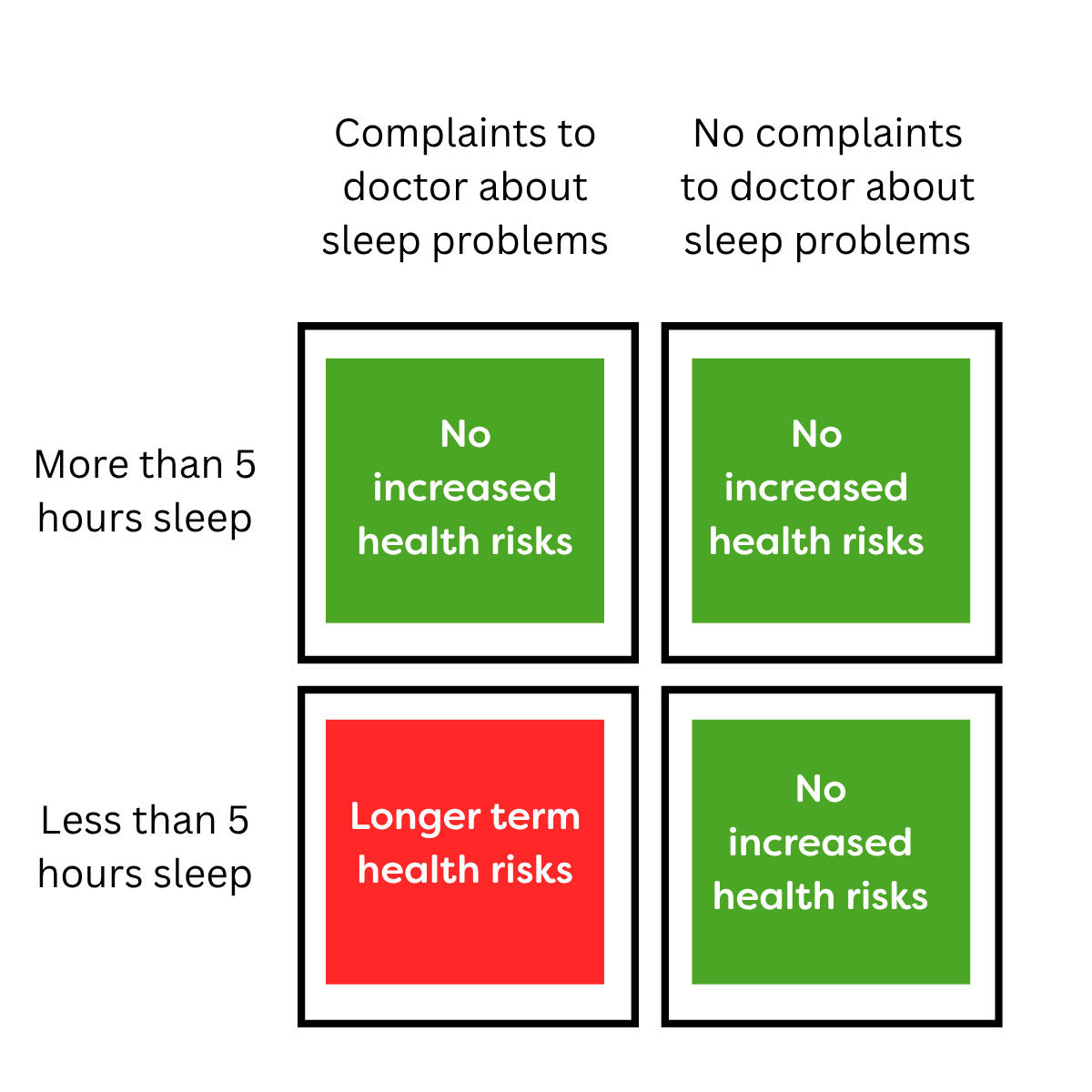
There are two studies in particular that show worrying about sleep causes more of the health risk than the number of hours actually slept.
In the Swedish study, researchers found that people who slept less than five hours on a regular, ongoing basis, AND who complained to their doctors about the sleep problem, did have longer-term health risks. But people who complained a great deal about insomnia while actually getting more than five hours of sleep did not have increased health risks. And people who slept less than five hours but did not complain about it — who simply thought it was normal, or that it was just how they had always been — did not have those health risks either.
Westerlund A, et al. Sleep Characteristics and Cardiovascular Events in a Large Swedish Cohort.
Eur J Epidemiol. 2013;28(6):463-473. doi:10.1007/s10654-013-9802-2.
The longitudinal study done in Canada showed almost no health risk once anxiety and depression were taken into account. Zolfaghari S, et al. Sleep Disorders and Mortality: A Prospective Study in the Canadian Longitudinal Study on Aging. Sleep Med. 2024;114:128-136. doi:10.1016/j.sleep.2023.12.023.
Give Yourself More Leeway
What I want to help you see is this: if you get six hours, that is okay. When you get less than six hours, you probably do not feel very good. But you have almost certainly made it through plenty of days on less than six hours before. You survived. It did not feel great, but you got through it.
So allow yourself a little more leeway. For what it is worth, my own average is probably under seven hours, and seven hours is a good amount for me. Once I get under six, or five and a half, I do not feel good during the day. I do not like it. I know how unpleasant that is, and how hard it is when you have a lot to do.
But the anxiety — checking the clock, calculating your hours of sleep, worrying, “Am I going to get enough sleep? Am I not going to get enough sleep?” — that is simply not needed.
And worrying, in the moment, generates adrenaline and cortisol, which then keeps you awake.
Practical Tips
1. Aim for a range in your mind, rather than a specific number of hours of sleep.
2. Learn and use diaphragmatic breathing, calming techniques, and progressive muscle relaxation.
Use these during the day, not just at night. How fast-paced your day is, and how much pressure you are under, affects your sleep.
Give yourself mini physiological resets throughout the day, do the same before bedtime, and if you wake up at 3 a.m., do some deep breathing. Actually, let me make this its own suggestion...
3.
If you wake up in the middle of the night and have a hard time going back to sleep, allow yourself to rest. Practice the diaghragmatic breathing or listen to a meditation tape. But rather than worrying about not sleeping, rather than worrying about how hard your day will be, focus on the fact that you are resting your body, which is very helpful, and healthy for you.
4. Follow the sleep hygiene rules you have probably seen everywhere. I will put together a video on that if you feel it would be useful — just let me know. These sleep hygiene rules come out of Cognitive Behavioral Therapy for Insomnia, or CBT-I. But sleep hygiene is not the only part of CBT-I.
5. And my next practical suggestion, if insomnia plagues you, is to look into CBT-I. If you can find a therapist who specializes in it, that is great. There is also a book I have used and think is excellent [book title not given in the source recording].
CBT-I is extremely well researched and very effective for insomnia. It has many components beyond sleep hygiene — one of which is sleep restriction. Research incorporating CBT-I has found that people who want to sleep eight hours, but whose bodies actually need only six or seven, can create more of a problem by trying to force more sleep. CBT-I has you do sleep restriction initially, which can be difficult, and is usually the last thing people suffering from insomnia want to do — but it has been shown to genuinely help over time. A video on CBT-I is coming as well [link: CBT-I video].
When to Check With Your Doctor
How much sleep you personally need can be judged more by how you feel during the day than by the numbers. If you consistently feel tired during the day, and feel that you are not getting enough sleep, it is worth checking with your doctor about the things that could cause daytime tiredness as well as insomnia.
Hypothyroidism can make you tired during the day. ADHD, or attention-deficit hyperactivity disorder, interrupts sleep cycles, and sometimes ADHD medication can actually help you sleep better — even though that seems counterintuitive given how the medication works. Sleep apnea is another known risk. I do not want to go through every medical possibility that could contribute, but I do encourage you to check them out. I am not a medical doctor — I am a psychotherapist, licensed, who saw clients for over twenty years — but I am not qualified to give medical advice, other than to say: check it out with your doctor.
Let me know: did this convince you that eight hours is a made-up number, driven by social media and our current obsession with turning everything into a sound bite? If you are still with me at this point, you know I am not very good at sound bites! — I do like to give people accurate and useful information!
I will see you next week.
Blog Author: Barbara Heffernan, LCSW, MBA. Barbara is a licensed psychotherapist and specialist in anxiety, trauma, and healthy boundaries. She had a private practice in Connecticut for twenty years before starting her popular YouTube channel designed to help people around the world live a more joyful life. Barbara has a BA from Yale University, an MBA from Columbia University and an MSW from SCSU. More info on Barbara can be found on her bio page.
Share this with someone who can benefit from this blog!