Waking Anxious at 3AM? This is what helps!

This is a subtitle for your new post

You wake up at 3 a.m., and you know you have not had enough sleep. It is SO frustrating. Most likely, anxious thoughts or rumination-type thoughts immediately flood your brain. If this happens to you, it probably happens regularly.
THis is such a painful type of insomnia, and it is so common.
Some people wake up with full-fledged panic symptoms. Others might be aware of a pounding heart or a racing pulse, and others just jump right into their to-do list, which they do not want to be doing at that hour!
Today I want to tell you what can help.
The first step is to understand the interlocking factors that make this such a common wake-up time. There is not one proven 3 a.m. mechanism.
It is a matter of how our regular, normal sleep biology works, combined with hyperarousal and a worry cycle that kicks in. Hyperarousal is very common for people who are very stressed. It could be a particularly difficult period in which you are stressed all day long, or it could be an ongoing anxiety problem.
The worry cycle also feeds on itself — worry that you are not getting enough sleep, or that you will not be able to cope further increases your anxiety ... and - arousal symptoms!
I think the biology of what is happening to us at that hour is one of the most important things to understand. Let us start there.
Five Factors to Understand Regarding The Biology of Waking at 3 AM
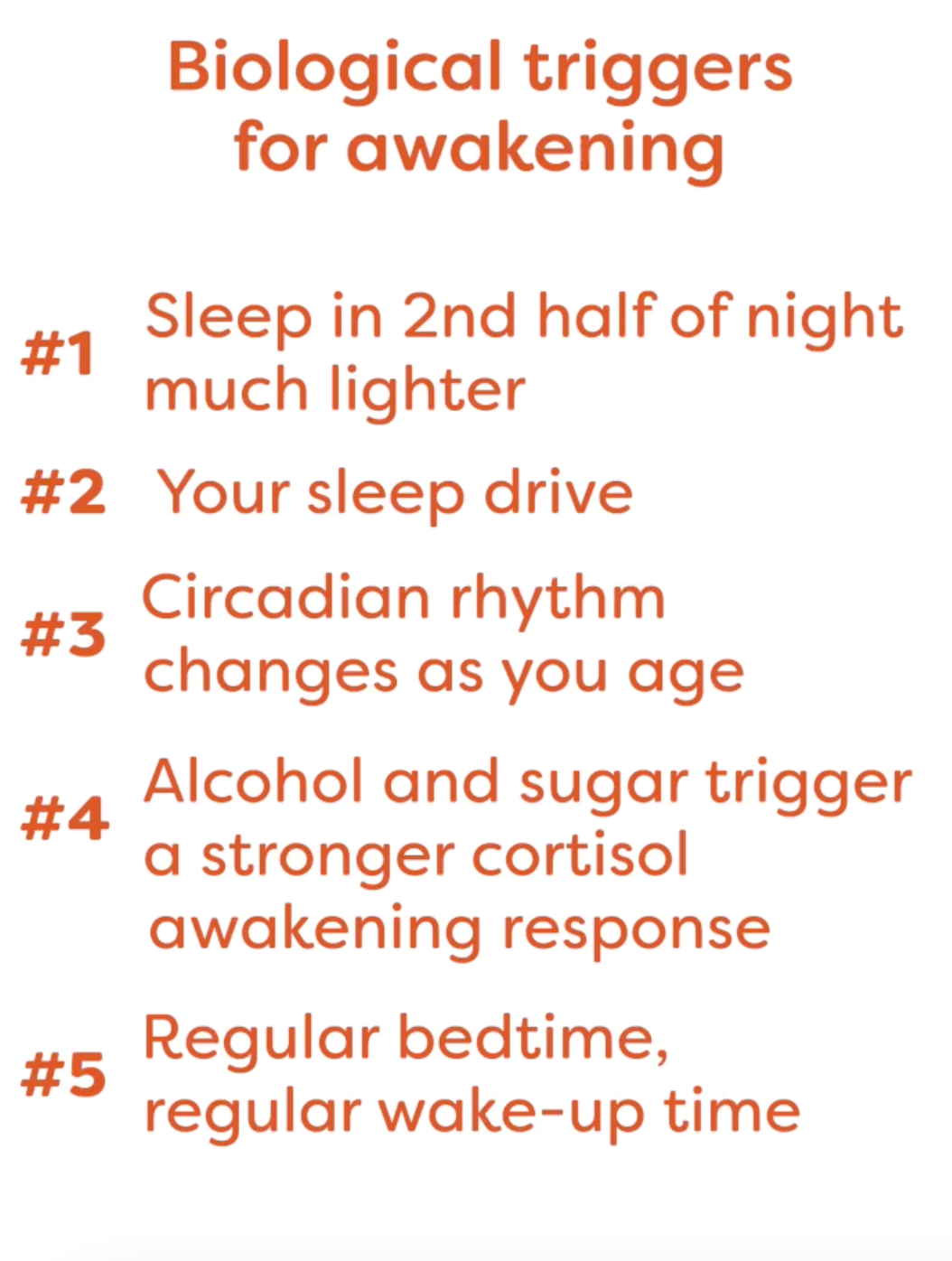
#1: Sleep in 2nd half of night much lighter
Our sleep in the second half of the night is much lighter than in the first half. Most of our deep, slow-wave sleep happens in the first half.
When you first fall asleep, you are in what is called N1, and then the sleep gets deeper and deeper. Once you enter the deep non-REM sleep, your blood pressure and heart rate are much lower than during your waking hours. Your parasympathetic nervous system — the calming nervous system — takes over, and your sympathetic nervous system, which is your fight, flight, freeze response, is reduced.
It takes a while to get into non-REM (rapid eye movement) sleepbut once you are in it, it is the deepest, most restorative, and most relaxed state.
#2: Your sleep drive
As you go through your day, your sleep drive begins to go up, particularly in the evening. That is the feeling of getting sleepy, then sleepier, then sleepier, until you finally go to sleep. Once you have fallen asleep and have been asleep for a few hours, your sleep drive begins to lessen. It is not fully satisfied, but it is not as strong, because it has been partially satisfied.
#3: Your circadian rhythm
Your circadian rhythm impacts your sleep drive: and determines when the drive is strongest and when it is satisfied.
Further, your circadian rhythm changes as you age. Particularly once you are over 65, your whole circadian rhythm cycle shifts toward being sleepy earlier in the day and waking up earlier in the morning, and probably needing less sleep.
#4 Alcohol and sugar trigger a strong cortisol awakening response
Here is where we have some control over the biological factors. Alcohol or sugar before bed will cause you to crash and be tired sooner, but they trigger a stronger cortisol awakening response.
#5 Regular bedtime and regular wake-up time
The other thing that is somewhat within our control — though not always — is whether we have a regular bedtime and a regular wake-up time. When we change those a lot, we are messing with our circadian rhythms. I know that for some people, with work schedules or kids or other caretaking, this is not always possible. But if you can keep a very set sleep schedule, it can help a great deal.
The Second Half of the Night
Impact of REM sleep
In the second half of the night, we are primarily either in REM sleep, where we dream, or in the much lighter stages of non-REM sleep. I hope that made sense — you can let me know in the comments.
During REM sleep, our blood pressure actually goes back to our waking level, and so does our heart rate. Sympathetic nerve activity has been shown to be almost double what it is even during our waking hours.
I am hoping this is already beginning to make some of you think about the fact that if all of that activity is happening in your sympathetic nervous system, which you are somewhat sensitive to because you have anxiety, it could easily cause you to wake up and to have anxiety when you wake. I will come back to how this all ties together.
Brief awakenings during this period of sleep are very common and normal, even for people who are very good sleepers. The difference is that good sleepers do not have a response to the awakening and probably do not remember it. During the later stages of our sleep, the REM cycles, we have mini awakenings with the 60-to-90-minute cycles.
Body Temperature and Cortisol
The other thing happening here is that once you hit that window of 2 to 4 a.m. — the exact hour can differ, but it is somewhere in the middle of the amount of time you want to be asleep — your body is beginning to prepare you to wake up eventually. Your body temperature falls when you go to sleep, but somewhere right around 3 a.m., it starts to go back up. Around the same time, your cortisol begins to kick in. This is the cortisol awakening response, and it happens for everyone: cortisol is quiet in the first part of the night, and then it begins to rise in anticipation of your eventually getting up.
Hyperarousal
So, now that you understand the biology that makes it likely to have awakenings in the second part of the night, lets talk about hyperarousal.
People with insomnia and/or anxiety have hyperarousal around the clock. If you are prone to worry and you wake up with all that energy at 3 a.m., your mind is going to immediately want to justify the anxious chemicals in your body. That is what anxiety does. When anxiety hits us somatically, our minds go, “Hm, I must be worrying about something,” or “I should be worrying about something,” or “What was that I was worrying about?”
People who do not have insomnia can also startle awake during these hours. They might startle awake, but then they are able to de-arouse — to calm down physiologically, reset, and go back to sleep.
The Antidote to Hyperarousal: Calming Your Body
This is where you have agency over changing a response. I know it is not easy and I am definitely not saying it is easy. But this is where learning some physiologically calming techniques can help considerably.
Practice During the Day
Even more important than practicing those calming techniques at 3 a.m. is practicing them during the day — truly practicing diaphragmatic breathing and grounding techniques, identifying the cognitive distortions that are probably increasing your anxiety, and doing what you can to lower the amount on your plate. Again, I understand — I had a very intense job, and children, all of that — and it is very hard to cut things off your plate. However, if you are running stressed all day long, and then you tell yourself, “Nope, time to sleep. Boom, I'm going to go to sleep,” that does not happen. A very lucky few can do that, to be honest. Whatever you can do to lower your stress response during the day is going to help you lower it at 3 a.m.
Slow-Paced Breathing
There is very strong, research-backed evidence that breathing at a rate of about six breaths per minute for 15 to 20 minutes before bedtime can help enormously. One study showed that this kind of breathing before bedtime helped people have fewer awakenings during the night and less time awake in the middle of the night [reference: study on slow-paced breathing before bedtime]. In other words, it reduced wake time during the hours when you want to be sleeping, and overall it improved sleep efficiency.
Six breaths per minute: best not to time this with a watch, of course. On your inhale, you can count to four or five — a nice, deep breath that does not involve the chest. It is about expanding your stomach. Take a nice, slow inhale to a count of four or five, whatever is comfortable for you, and then a nice, slow, regular exhale to a count of five or six. I have a whole video on diaphragmatic breathing techniques, which I will link here [link: diaphragmatic breathing video].
This breathing can help during that 3 a.m. awakening, but doing it in the evening is the most effective.
Further, when I was working with people with anxiety, I would recommend five minutes of diaphragmatic breathing three times during the day, and then a slightly more extensive session in the evening before bedtime. It is simple. It can be done anywhere. People do not even need to see you doing it. It is free, and it is always with you.
Worrying About How Much Sleep You Get
The third contributing factor, which I mentioned earlier, is worrying about how much sleep you get. I put out a video on how we do not all need eight hours of sleep — a myth that has become very popular. I will link that video; it might be helpful for you [link: The Eight-Hour Sleep Myth].
Even without aiming for eight hours, I understand what it is like to go through a day without enough sleep. It is very unpleasant, sometimes even painful, but anticipating that, judging it, and thinking a lot of thoughts about it is only going to make your sleep worse.
Again, this is not an easy step. Most sleep experts will say not to look at the clock. Do not calculate how many hours of sleep you have had, how many you need, how many more you need, or how long you have been awake. Do not do all those calculations in your head, because they are just fueling your anxiety. Instead, you can do the slow-paced breathing. You can let yourself know, “Well, this is just what's happening right now. I'd rather be asleep, but I also can try to relax as much as I can here in this comfortable bed and give my body some physiological rest, even if I'm not sleeping.”
The 20-Minute Rule and CBT-I
I also want to throw in here that sleep experts will say that if you cannot get back to sleep within 20 minutes, it is better to get out of bed and do a calming activity, and then come back in when your sleep drive gets a little stronger. That is part of CBT-I, ("Cognitive Behavioral Therapy for Insomnia).
I am doing a whole series on insomnia [link: insomnia series], and I am about to release a video on CBT-I. It has been proven to be incredibly effective at helping people sleep better, no matter what the cause.
If this has been helpful for you, let me know on YouTube. Share this with someone you think it could help.
See you next week!
Blog Author: Barbara Heffernan, LCSW, MBA. Barbara is a licensed psychotherapist and specialist in anxiety, trauma, and healthy boundaries. She had a private practice in Connecticut for twenty years before starting her popular YouTube channel designed to help people around the world live a more joyful life. Barbara has a BA from Yale University, an MBA from Columbia University and an MSW from SCSU. More info on Barbara can be found on her bio page.
Share this with someone who can benefit from this blog!