Why Can't I Let Things Go? (When Your Brain Won't Stop)

Does your brain drive you nuts going over and over the same thing—the mistake you made, the difficult conversation you had....anything you are worried about?
If you relate to this, you're in the right place.
Your brain's habit of going over and over things is not a character flaw. It is not a lack of discipline. What you are experiencing is a habitual pattern of your brain, and one that is common to many people. And, it is important to know that this pattern CAN be changed. Your brain can be retrained.
What Is Rumination?
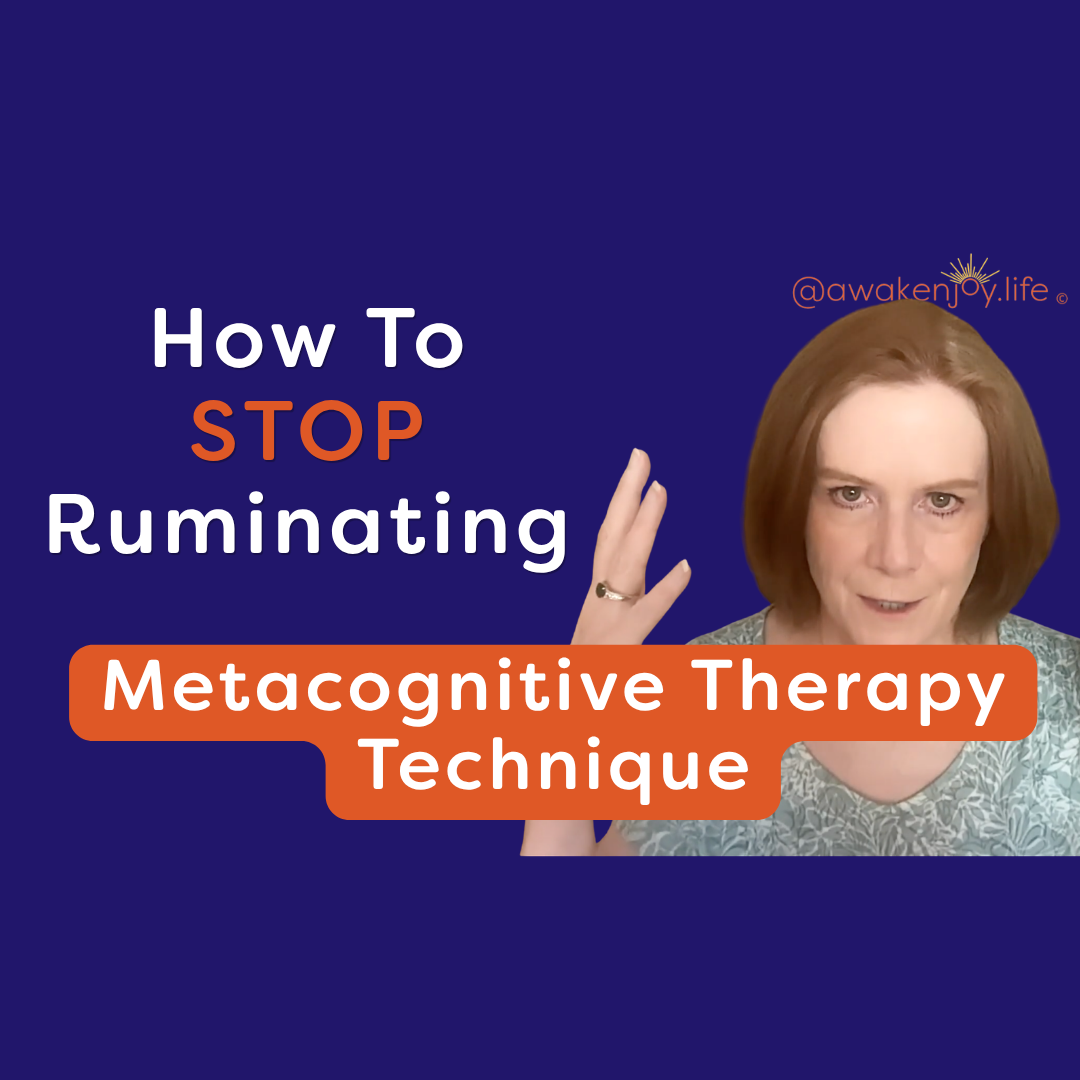
The habitual pattern of going over and over something is called rumination. It is a compulsive focus on the distress you are feeling, on what might have caused it, and on what the consequences might be. Rumination doesn't flow into problem solving, so it is non-productive. Once in awhile, it might feel like it is moving into problem solving, but then it just loops right back to the same thoughts you began with. You feel stuck. Stuck in the problem and in the thought pattern.
Rumination tends to have some common themes:
- Blame: Who's to blame? Is it you? Someone else?
- Unfairness: Thoughts circle around "Why me? Why did this happen to me?" and "It's not fair!"
- Relationship Issues: A relationship that went wrong can send as spinning. Even a difficult conversation can trigger rumination.
- Mood: Going over and over how you are feeling. "Oh, I'm anxious. Why am I anxious?" Or: "I'm depressed. I shouldn't be depressed!"
- Self-Criticism: Through all of these, self-criticism runs rampant.
As you review these themes, you'll notice that all of them are turned inward. They're all about "me". The focus is on our own feelings, our faults, what we did, what we didn't do, or what was done to us.
The Default Mode Network (DMN)
This inward focus is part of something called the default mode network. The default mode network is a network of different parts of our brain. This network turns on whenever we're not engaged in something external to us. If we're focused externally on a task that we are interested in, or focused on a person or a movie— the DMN is not engaged.
But when we're NOT externally focused, that network turns on.
The DMN can be great for creativity. It's also useful for making meaning out of the events we've experienced. It's a part of the brain that connects past experiences to the future—to what might happen in the future and what we might want in the future. It also scans for unresolved problems. So it definitely has its positive uses.
But in people who might be inclined towards anxiety or depression or who struggle with ADHD, the DMN can get stuck in a self-destructive loop. The self-referential thoughts, the "me loop" filled with self-criticism, blame of self and others, revisiting perceived failures and projecting future disasters - this "me loop" is very painful.
You can see why one of the solutions to rumination is to shift your focus outward. (I do have some blogs that provide more detail on this which you can find here:
Compulsive Rumination and
Ruminating? The Missing Piece.
.
Three Brain Tendencies That Fuel Rumination
The human brain has some well-proven tendencies that contribute to rumination:
- Negativity bias
- A love for stories
- A need to remain occupied
These three things together fuel the tendency towards rumination which plagues a very large percentage of the population.
The negativity bias in particular is probably tied to our early caveman days where we had to stay focused on survival every second of the day. Our brains are wired to notice and hang on to threats and potential threats much more than they are wired to hold on to the positive moments in our lives.
Additionally, brains like to conserve energy. So you might think that rumination takes up a lot of energy—which it does—but rumination is fueled by automatic thoughts. Automatic thoughts conserve energy - our brains are being efficient and jumping to what we already think is the conclusion: automatic thoughts such as "I'm stupid," "I'm worthless," or "I'm not good enough."
And further, the repetition of the automatic thoughts and the rumination further ingrains into our brains this pattern.
The Solution: Developing the Observer Brain
The skill that changes everything involves developing the "observer brain."
The observer brain is the part of us that looks at our thoughts instead of being consumed by them. Instead of being completely caught up in the story that our rumination is telling us, the observer brain says, "Oh, there I go again. There's that rumination." The observer brain can see how the rumination is completely "me-focused." The observer brain can also see tht the rumination is triggering stress chemicals because our brain can't differentiate between what the rumination is telling us and what is actually happening.
So this observer brain utilizes "metacognition." Metacognition is basically a thought about a thought.
As you strengthen your metacognitive abilities—or your observer brain—your ability to look at and step back from your thoughts increases.
Metacognition creates just enough distance to loosen the tight focus on the "me loop." Metacognition is the first step in being able to shift your attention elsewhere.
So developing this part of your brain is like any other part of your brain—it is a matter of practice. The blogs I linked above provide some specific and actionable steps for you to take to strengthen the observer brain, to shift your focus, and to get out of the rumination loop.
If you got value out of this blog post, please do share it with someone who might benefit. Comment below with any questions you might have or any comments. I'd love to hear from you and I'll see you next week!
Blog Author: Barbara Heffernan, LCSW, MBA. Barbara is a licensed psychotherapist and specialist in anxiety, trauma, and healthy boundaries. She had a private practice in Connecticut for twenty years before starting her popular YouTube channel designed to help people around the world live a more joyful life. Barbara has a BA from Yale University, an MBA from Columbia University and an MSW from SCSU. More info on Barbara can be found on her bio page.
Share this with someone who can benefit from this blog!