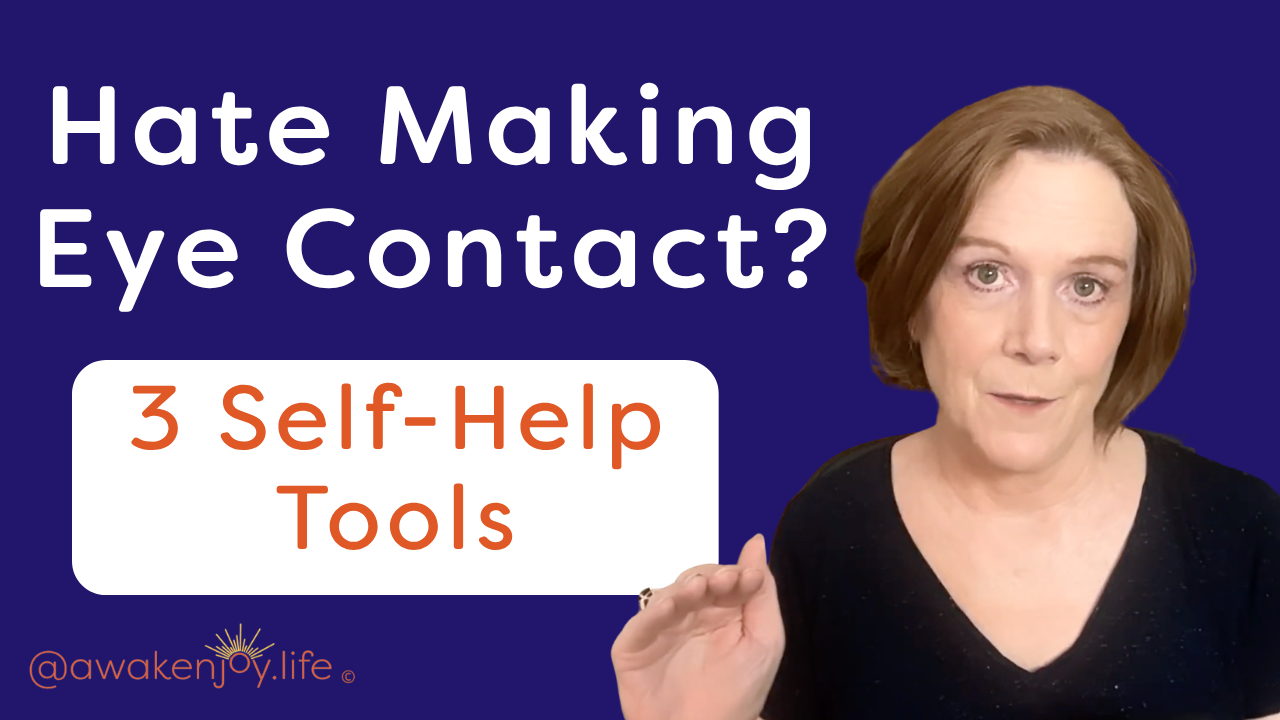
Fear of Eye Contact and Being Judged? 3 Tools to Help Social Anxiety

If you're terrified of eye contact and constantly worried about what others think of you, you're not alone.
These experiences are fairly common and often point to something deeper—social anxiety disorder. While fear of eye contact and judgment alone do not qualify for a diagnosis of social anxiety, if you recognize these patterns in yourself, it's worth exploring whether social anxiety might be affecting your life.
The good news? Social anxiety is very treatable, and many people successfully recover from it.
Understanding the Challenge
Making eye contact can feel incredibly vulnerable. When we look someone directly in the eyes, we're often silently asking, "What are they thinking about me?" For people with social anxiety, this becomes particularly challenging because it can feel like others are scrutinizing you or seeing right into your insecurities.
Your brain responds by trying to avoid that discomfort: "That's scary. That doesn't feel good. I'm just going to avoid doing it."
However, avoiding eye contact actually makes social anxiety worse. Interactions may feel even more awkward without that connection, creating a self-reinforcing cycle. Avoidance is a hallmark of all anxiety disorders, and unfortunately, avoidance always makes things worse over time.
Social anxiety can also cause your world to shrink more and more. You might start avoiding social events, skip meetups with friends, or find that it impacts your work performance. But recovery is absolutely possible.
The Best Researched Treatment
The best-researched treatment method for social anxiety is Cognitive Behavioral Therapy (CBT). [I do have videos and blogs on CBT which I’ll link here]. However, many people don't have access to therapy, which is one reason I produce videos for my YouTube channel and publish blogs here.
If you begin to treat your social anxiety as an anxiety—any kind of anxiety—you'll begin to practice with both the cognitive tools (how to change how you think) as well as the somatic tools (how you calm your body down, lower your stress and anxiety level overall). When you can apply that to specific social situations, things can get better.
Regardless of whether you're working with a therapist or practicing self-help, understanding these principles can make a significant difference.
Three Practical Tips You Can Start Today
1. Shift Your Focus Outward
Social anxiety is fueled by what I call the "me loop"—a term I didn't create but find incredibly useful. This happens when your thoughts get stuck on self-focused questions:
• What do they think of me?
• Did I do something embarrassing?
• Am I saying the wrong thing?
In that mental space, the other person barely exists at all.
The Solution: Apply genuine curiosity in your social engagements. Ask yourself: What is this other person like?
Remember, the person you're talking to has their own insecurities, their own grief, their own positive and negative experiences. They're a human being, just like you. Find something out about them. Genuine curiosity is a wonderful social skill and a wonderful tool for recovery from social anxiety. This shift can cut the loop of anxious thoughts and feelings and make social interactions feel much more manageable.
2. Explore the Fear: Ask "So What?"
This exercise is challenging, but it's worth doing. When fear arises, push deeper with the question "so what?"
Let’s say the person in front of you is judging you. With each answer, ask “so what?” and see where it goes. For example:
• "What if they're judging me?" → So what?
• "They'll think I'm stupid." → So what?
• "They won't want to be with me." → So what?
• "Then I won't have any friends." → So what?
• "Will I survive?"
What's happening with social anxiety is that your old brain, your amygdala, is responding to social interactions and responding to negative judgment as if it is life-threatening. Your body is having a complete fight-flight-freeze response, and mainly with social anxiety it is a freeze or flight response.
This biological response was necessary when facing a saber-tooth tiger—it's not necessary during a social interaction.
I think this social anxiety was embedded in us a long time ago, possibly during the hunter-gatherer stage of human existence. You needed your clan to stay safe, and being ostracized from that clan was life-threatening in the immediate sense. While being excluded today won't threaten your physical existence in the same way, your amygdala is reacting as if it's threatening your existence right now, and right this second, it's not threatening your physical existence.
Understanding this mismatch between your body's response and actual reality is crucial for recovery.
3. Practice Eye Contact in Low-Stakes Situations
Begin to practice eye contact in low-stakes situations. When you go to buy groceries, make eye contact with the person who hands you your change or checks you out. Make eye contact with a neighbor that you don't know but pass in the hallway. Nod. Say hi. Make eye contact—that's it.
As you make eye contact and nothing terrible happens, you are retraining your brain that eye contact is safe. It's okay.
Key Principle: One of the keys to recovering from social anxiety is to not avoid. Don't avoid the situations that make you anxious. Sometimes the work of recovery means that temporarily your anxiety will go up because you'll be facing those situations that make you anxious.
Additional Therapeutic Approaches
When I worked as a therapist, I frequently used **EMDR **(Eye Movement Desensitization and Reprocessing) because a lot of people with social anxiety actually had traumatic events that started the social anxiety. These are called trigger events. Processing these events can be transformative.
Often, anxiety ties back to negative core beliefs about yourself—beliefs that you're defective, not okay, or somehow in danger because of others' judgments. I offer a free PDF that helps identify these negative core beliefs and provides three methods to begin overturning them, facilitating long-term recovery.
Your Path Forward
If you're resonating with this, do check out my other videos and blogs on social anxiety. Remember, recovery is a journey that requires patience and practice.
Blog Author: Barbara Heffernan, LCSW, MBA. Barbara is a licensed psychotherapist and specialist in anxiety, trauma, and healthy boundaries. She had a private practice in Connecticut for twenty years before starting her popular YouTube channel designed to help people around the world live a more joyful life. Barbara has a BA from Yale University, an MBA from Columbia University and an MSW from SCSU. More info on Barbara can be found on her bio page.
Share this with someone who can benefit from this blog!