Interoceptive Exposure: A Powerful Technique for Anxiety

Interoceptive exposure can be transformative for people with somatic anxiety, specifically panic attacks, PTSD, OCD and health anxiety.
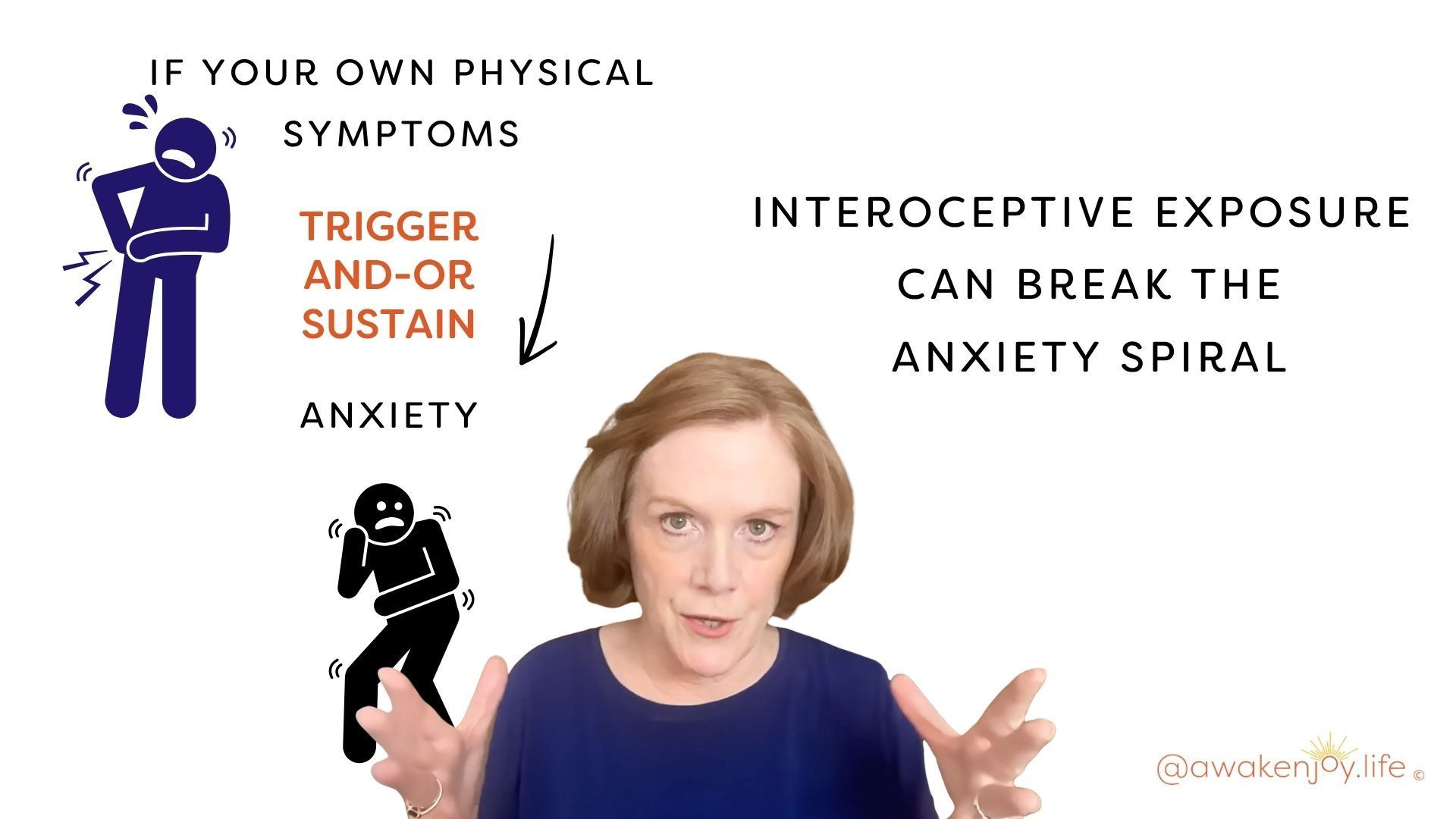
Your physical symptoms may have become a significant trigger for your anxiety, perhaps even the primary trigger. Or your physical symptoms might contribute to sustaining your anxiety cycle because they cause you to do what you can to avoid the sensations and the situations that cause those sensations.
These sensations can include a racing heart, stomach ache, palpitations, or noticing a strange pain somewhere in your body. When these physical sensations are interpreted as danger, your natural inclination is to avoid them and become distressed when they appear.
Interoceptive exposure is essentially exposure to your own internal symptoms. "Interoceptive" means looking inside—it's awareness of what's happening in your body. This technique is used in Cognitive Behavioral Therapy (CBT), where you intentionally recreate some of those symptoms in a safe environment with a therapist. Like any exposure therapy, if you can tolerate the anxiety and sit through it, the panic you feel from those symptoms will gradually decrease.
Through this process, your old brain—your amygdala and nervous system—learns that these sensations are actually not dangerous.
How Interoceptive Exposure Works in Clinical Settings
In a clinical setting, the therapist and client identify which physical sensations contribute to anxiety spikes. They then brainstorm ways to recreate those physical symptoms in the therapist's office.
For example, if shortness of breath and a spike in your pulse rate or racing heart are triggers, you might run in place for 30 seconds as fast as you can to recreate those symptoms. As you feel them, the therapist will ask, "How distressing is that to you on a scale of 0 to 10?" We use the term Subjective Units of Distress, or SUDS for short, to measure how upsetting a feeling is to you.
In my clinical practice over twenty years, I worked with many clients with PTSD and cPTSD. When clients revisit traumatic memories or upsetting events, they often begin to re-experience the physical sensations of the trauma simply by thinking of those memories. The link between the trauma and the physical sensations is often very upsetting.
I found EMDR therapy (Eye Movement Desensitization and Reprocessing) highly effective in helping clients recover from PTSD and cPTSD. EMDR therapy utilizes the concepts of Interoceptive Exposure by helping the clients sit with the physical and emotional feelings tied to the trauma. As the client would experience these emotions with more tolerance of the anxiety they cause, and more curiosity, the feelings generally waned. And how upsetting those feelings were would also wane.
This process involves mindfulness—being mindfully aware of physical sensations, noticing them without judgment, and allowing yourself to truly feel them without feeling compelled to make them stop. Over time, clients develop a greater sense of "I can handle this. It's okay. My heart races and then it calms down."
Research-Backed Effectiveness
The concept of exposure—not avoiding what you're afraid of—is a common theme throughout almost all anxiety recovery. Interoceptive exposure was originally developed for panic disorder, and extensive research shows it is extremely effective for this condition.
Various techniques have been used in research and clinical settings, such as having clients spin in a chair to evoke dizziness if that is a trigger, or breathing through a narrow straw to evoke the feeling of not getting enough air.
Even hearing about these techniques might make you feel anxious because the fear of those physical sensations is so strong. However, in various research projects, there were really no adverse effects on people from doing this, even though many people were initially afraid to attempt it.
Applications Across Different Conditions
I've discussed how this applies to PTSD when physical sensations are linked to trauma. This technique helps those two things become decoupled or separated.
Interoceptive exposure (IE) is now also being incorporated into OCD treatment more frequently because much of OCD is triggered by some type of internal sensation. It could be an uncomfortable physical sensation or an urge, and then that urge begins the cycle for someone with OCD.
How to Apply These Principles on Your Own
You can utilize these principles even if you're not in formal therapy. Here's how to begin:
Start Gradually
Begin with some of the lower-intensity physical sensations, not necessarily the ones that cause the biggest anxiety spike. This gives you time to practice.
Create a Sensation Inventory
Write a list of which different physical sensations trigger anxiety, then rank them. Pick one or two to work with.
Notice
Notice when the physical sensation arises and pause before you try to jump away from it.
Approach with Curiosity
Approach the sensation with curiosity:
- What does that physical sensation feel like?
- Where are you feeling it in your body?
- If it had a color, what color would it be?
- Is it hot? Is it cold?
Notice the Thoughts and Separate
Notice what thoughts this physical sensation links to. Perhaps jot the thoughts down. See if you can separate the observation of the feeling from the thoughts.
Slow Things Down and Notice if the Physical Sensation Changes
By slowing things down and separating the physical sensation from thoughts about its danger, you create space for new learning. As you observe the physical sensation, notice if it's changing. Does it change as you pay attention to it?
Try to Reframe Your Thoughts About the Feeling
Try to move toward the feeling of "I can feel this sensation and also know that I'm safe enough." If you can stay present with these sensations, they will calm down.
This will help your old brain update its assessment of that feeling.
Expect Initial Challenges
As you begin to try to sit with these feelings, you might notice that your anxiety increases initially. One of the hardest aspects of all exposure therapy is that when you allow yourself to be exposed to things you're afraid of and have been pushing away, it does create a spike in anxiety. This is actually why many people drop out of exposure therapy—it feels too intense.
However, increasing your tolerance for feeling the anxiety is what provides long-term relief.
Additional Resources
I offer a free webinar called "Rewire Your Brain for Joy and Confidence." In it, I discuss some of the best tools for beginning to rewire the pathways that have developed—pathways that have likely been forming since childhood. These pathways tie certain physical responses to events and situations in ways that can sustain the pain of those events.
I also have videos on avoidance and
why avoidance makes anxiety worse. If you're working with a therapist, they may not have heard of the concept of Interoceptive Exposure using these exact terms, but they might be willing to look into it and see if they're comfortable working with you on some of this.
If you found this article helpful, please share it with someone who might benefit. Understanding and working with your body's signals can be a crucial step toward lasting anxiety relief.
Blog Author: Barbara Heffernan, LCSW, MBA. Barbara is a licensed psychotherapist and specialist in anxiety, trauma, and healthy boundaries. She had a private practice in Connecticut for twenty years before starting her popular YouTube channel designed to help people around the world live a more joyful life. Barbara has a BA from Yale University, an MBA from Columbia University and an MSW from SCSU. More info on Barbara can be found on her bio page.
Share this with someone who can benefit from this blog!