Health Anxiety: When Worry Feels Necessary

Barbara Heffernan • March 19, 2026

You constantly check your state of health. You research your symptoms.

You tell yourself you are being responsible. Vigilant. Careful about your health. But part of you understands that the constant worry is weighing you down. Yet, you just can't imagine it is reasonable to stop paying so much attention. 
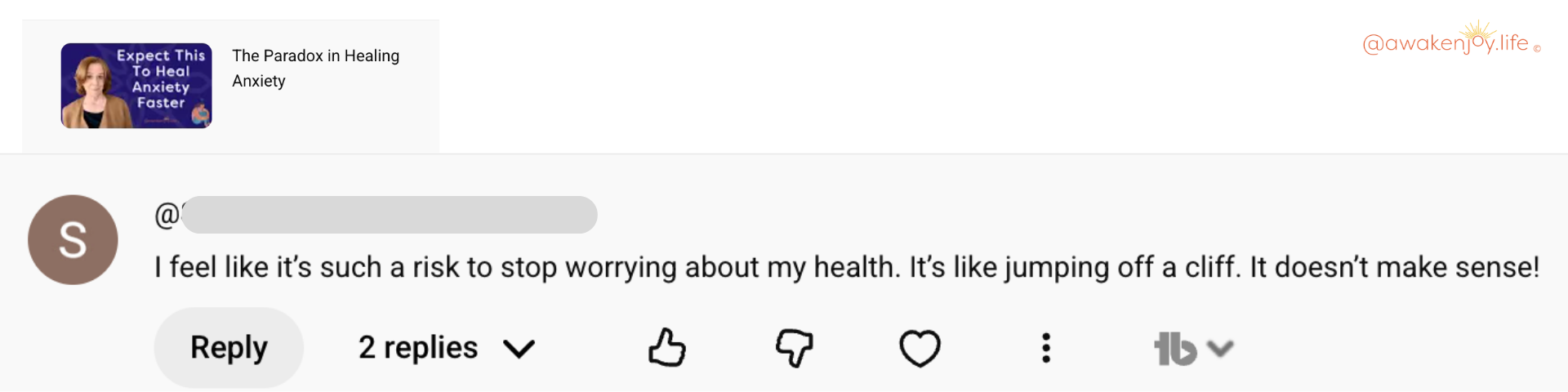
Recently, I received a comment that captured this experience perfectly, and it highlights a core concept at the heart of health anxiety.  
 
"I feel like it is such a risk to stop worrying about my health. It is like jumping off a cliff. It does not make sense."

If you have ever felt this way, you are not alone. And there is logic to this fear—your brain has convinced you that the worry is keeping you safe.

But what if I told you that the exact opposite is true? What if the worry is not protecting you from the cliff—what if the worry IS the cliff? What if the anxiety itself is the concering problem you need to address?

The Core Issue with All Anxiety

A central issue with all anxiety is that it convinces us that it is necessary.

Our anxiety wants to protect us. And, sometimes, anxiety in a reasonable amount—a manageable amount—makes sense. It encourages us to examine the problem, search for solutions, and take appropriate action.

But anxiety is driven by a very ancient part of our brain—our survival response—and it becomes entangled with our logic. We struggle to distinguish between reasonable concern and problematic anxiety.

In working with clients as a psychotherapist over 20 years, this inability to distinguish helpful concern from destructive worry was at the core of most health anxiety I encountered.

The Logic Behind Health Anxiety

Let us look at the logic of the statement "I cannot stop worrying about my health," because it does have logic:

    • I have to stay vigilant about my symptoms. If I stay vigilant, I will catch something early before it becomes a much worse problem.
    • It is not responsible to ignore my health issues.
    • Worrying means I am being responsible and taking my health seriously.
    • If I stop, something will slip through.

Your brain feels like it is supposed to do this. 

The worry itself feels functional. The worry actually feels like action - it makes you feel that you ARE doing something to address a problem.

For many people with health anxiety, once they take action—see a doctor or research something more thoroughly online—they feel momentary relief. We will talk more in a moment about how that momentary relief actually feeds the anxiety cycle.

Anxiety Can Cause Hypervigilance About Your Health or Completely Avoidance

I also want to mention that many people with health anxiety actually avoid the issue entirely. They avoid thinking about their health. They avoid going to the doctor.

Anxiety can cause one to be hypervigilant OR to avoid.

However, I am assuming that most readers here are hypervigilant about their health (as those who avoid will avoid this blog!).

(If you are an avoider - let me know here or on my YouTube channel and today's video - I can create a video and blog to address that). 

Research shows that the healthiest people occupy the middle ground—neither hypervigilant nor avoidant. They follow up with preventative care, see their doctor regularly, and adhere to general health guidelines. But they do not see their doctor constantly or worry excessively between visits.

The Vicious Cycle of Reassurance-Seeking

Health anxiety trains your brain to constantly scan for any possible problem, any potential symptom. When you engage in reassurance-seeking activities—consulting a doctor for confirmation that nothing is wrong, requesting additional tests, or researching symptoms online—that brief relief perpetuates the cycle.

The relief itself reinforces the behavior. Your brain learns that this is the correct response, that this is what provides temporary comfort. The cycle becomes self-reinforcing and increasingly difficult to break.

The protection your anxiety promises is an illusion. It is not keeping you safe; it is maintaining your distress.

This is what I mean when I say the anxiety itself is causing you to fall off the cliff. The anxiety itself has become the problem that requires treatment.

If this is resonating with you, I have a free webinar called Rewire Your Brain for Joy and Confidence. In that webinar, I talk more about how we develop these patterns in our brain, how our neurobiology is reinforced by the patterns of our behavior and thinking, how those fit together with particular situations, and the best ways to change it so you can rewire that. Many people have found it incredibly helpful.

Why Stopping the Worry Feels So Dangerous

This applies to many anxiety disorders, not just health anxiety. When we focus on worrying about a problem, it feels counterintuitive—even reckless—to stop.

But consider how your brain—the primitive, survival-oriented brain—has been conditioned to seek that momentary relief. Once you understand this conditioning, it becomes clear why it feels so dangerous to stop the hypervigilance.

You are asking a brain that has been trained in one direction to reverse course entirely. Your amygdala interprets your attempt to stop hypervigilant activities as a threat.

But the fact that your amygdala registers it as danger, and the fact that it feels dangerous to stop double-checking and overchecking, does not mean it is dangerous.

This bears repeating: Just because it feels dangerous to stop the compulsive behaviors that fuel health anxiety does not mean it is actually dangerous.

This principle applies to numerous anxiety disorders. Many people who experience panic feel their panic symptoms are life-threatening. The feeling of danger does not make the danger real.

When you attempt new behaviors or discontinue repetitive patterns, resistance inevitably emerges. But behavioral change is precisely how we most effectively rewire the primitive parts of our brain.

What Actually Helps: The Complete Approach

What benefits both your physical health and your mental health is treating health anxiety as an anxiety disorder that requires the complete, integrated approach to recovery. Last week's video and blog provides a more thorough description of the Complete Approach to Anxiety Recovery (video here and blog here). 

1. Develop Your Observer Brain

The observer brain is the part of you that can step back and notice what is happening without being consumed by it. With health anxiety, the observer brain recognizes that the worry itself feels protective and safe to you. It observes the habitual patterns—the scanning for symptoms, the researching, the reassurance-seeking—without judgment.

This observer perspective allows you to see the cycle rather than simply being trapped inside it. You can notice: "I am doing that thing again where I convince myself this symptom means something serious." Or: "I am doing that again where I feel I HAVE to worry about this."

This awareness itself begins to create distance from the anxiety. 

2. Use Your Logical Brain for Problem Classification

Once the observer brain has created some distance, the logical brain can engage in what I call problem classification rather than problem dismissal. This means asking yourself: "Is this level of anxiety necessary to address this situation? Do I need to be this anxious, accelerating all of these anxious feelings in my body, in order to take care of my health?"

Or can I pause, regulate my nervous system first, and then assess the actual problem with greater clarity? 

Problem classification helps you distinguish between genuine health concerns that require action and anxiety that requires different treatment.

3. Implement Somatic Techniques

Somatic techniques work from the body up to calm the mind. These include progressive relaxation, grounding exercises, and nervous system regulation through diaphragmatic breathing. These tools directly counteract the physiological anxiety response that health anxiety triggers.

When you calm your nervous system, you reduce the physical sensations that health anxiety often latches onto. This breaks the cycle where physical anxiety symptoms get misinterpreted as evidence of illness, which then creates more anxiety.

4. Apply Cognitive Techniques

Cognitive techniques help you identify and challenge the thought patterns that fuel health anxiety. Ask yourself: Am I catastrophizing? Am I taking a minor symptom and imagining the worst possible outcome? Are there cognitive distortions happening—perhaps all-or-nothing thinking or overgeneralization? Am I ruminating, going over the same worries repeatedly without reaching any resolution?

All of these patterns indicate anxiety rather than genuine health concerns. When you can identify them, you can begin to respond differently.

5. Change Your Behaviors 

This is the component that often gets overlooked, but it is the most important for rewiring your brain. Behavioral change means actively doing something different from what the anxiety is telling you to do.

For health anxiety, this means stopping the reassurance-seeking behaviors: limiting how often you research symptoms online, resisting the urge to ask your doctor for yet another test when you have already been cleared, not seeking constant reassurance from friends or family members.

It also means engaging in healthy activities that redirect your attention and energy: taking a walk, spending time with a pet, pursuing meaningful engagement with hobbies or relationships. You are essentially teaching your brain a new pattern—one where you can feel a physical sensation without immediately spiraling into health catastrophizing.

This retraining process is cumulative. Change accumulates gradually. Your capacity for tolerating uncertainty and discomfort without resorting to compulsive checking strengthens with consistent practice over time.

The Goal of Recovery from Health Anxiety

The goal of recovery is not to stop caring about your health. Rather, it is to relate to your health the way someone without health anxiety does.

This means attending to preventative care, scheduling annual physicals, maintaining awareness of your body—but not scrutinizing every sensation, not transforming every ache into a terrible possibility.

It means understanding that anxiety itself generates numerous physical symptoms. Learning somatic techniques to regulate your nervous system. Approaching your health with appropriate concern rather than catastrophic thinking.

The Core Concept

At its core, the fundamental insight about health anxiety is this:

Caring for your health does not require anxiety.

The anxiety, however, requires treatment.

These are two separate concerns that require two different approaches. Once you can separate them, recovery becomes possible.

I recognize this is a complex, difficult issue. Please share in the comments what resonated with you, what questions remain, and what you would find most helpful to explore further.

Blog Author: Barbara Heffernan, LCSW, MBA. Barbara is a licensed psychotherapist and specialist in anxiety, trauma, and healthy boundaries. She had a private practice in Connecticut for twenty years before starting her popular YouTube channel designed to help people around the world live a more joyful life. Barbara has a BA from Yale University, an MBA from Columbia University and an MSW from SCSU.  More info on Barbara can be found on her bio page.

Share this with someone who can benefit from this blog!
By Barbara Heffernan May 29, 2026
If you view your emotions as something to be avoided, squashed or feared — you are activating your your amygdala, and setting off internal alarm bells. This makes everything worse. Research has shown there are six beliefs that drive emotional dysregulation. Which one is yours?
By Barbara Heffernan May 18, 2026
Emotional distress : its intensity and duration is driven by certain beliefs. Learn 3 tools to help regulate your emotions. This has substantial research behind it – and an expert explains.
By Barbara Heffernan April 23, 2026
The main thing that drives rumination is actually the BELIEFS we have about the FEELINGS that come up from a difficult situation. Rumination is driven by the habitual patterns of thinking combined with our judgments about whether we can handle the emotions, both of which can be changed to experience relief.
By Barbara Heffernan April 3, 2026
You can probably recall a time when you were with someone who was intensely anxious—and within minutes, you began to feel anxious yourself. Perhaps your heart rate increased. Your breathing became shallow. The knot in your stomach tightened. Or maybe you remember the opposite: a time when you were with someone who was truly grounded and calm, and their presence actually calmed you down. Your shoulders dropped. Your breathing deepened. The tension you had been carrying began to dissipate. This is not your imagination. This is emotional contagion, and it is scientifically proven. Understanding how your own emotional regulation—or lack thereof—impacts other people, and how other people's emotional states impact you, is essential for healthy relationships. Learning emotional regulation tools can improve your relationships significantly. Learning how to lower your susceptibility to emotional contagion can help as well. In this article, I will explain what emotional contagion is, how it impacts relationships, and provide five specific strategies for improving regulation in your own relationships. What Is Emotional Contagion? Emotions are contagious. Extensive research—both behavioral research and neuroscience—shows that we pick up the emotions of the people around us. The closer our relationship with them and the more invested we are in that relationship, the more this phenomenon occurs. This may not always feel accurate because we also tend to balance each other out. If someone is very upset, we might suppress our own emotions in response. But as I will explain, that suppression is actually part of the same dynamic. Three Pathways to Emotional Contagion There are three pathways that lead to emotional contagion: Pathway 1: Automatic Mimicry Unconsciously, when we see facial expressions in another person, we mimic them. If someone smiles, we tend to smile immediately. If someone frowns, we might make the same expression. This happens not just with facial expressions but also with voice, tone and body posture. Pathway 2: Autonomic Mimicry This involves our autonomic physiological system which works in synchrony with other people. Our heart rate, our breathing rhythm, and even our pupil dilation tend to mimic each other. Our nervous systems influence each other constantly. Pathway 3: Affective Convergence This is the convergence of feelings. When our facial expressions and body posture mimic another person's, and our physiological system aligns with theirs, we develop the same affective feelings. We end up experiencing a version of that emotion ourselves. The Suppression Trap: Why "Staying Calm" Can Make Things Worse If someone is extremely upset, you might calm way down. If this happens almost automatically, you are probably suppressing your emotions rather than regulating them. Extensive research shows that when one person suppresses their emotions, it actually makes the other person more anxious. And the person who is suppressing—while they might appear calm externally - is experiencing all the physiological signs and symptoms of anxiety or a heightened emotional state. Even when we are trying to be the balance in the room, we might actually be escalating the emotions present. This is particularly true for those who grew up parentified. Adults who were parentified as children often feel their emotional regulation is better than anyone else's in their families. While that might be true to some extent, without substantial self-awareness and genuine emotional regulation tools, you are likely using emotional suppression, not regulation. Where Emotional Regulation Patterns Come From The means by which you emotionally regulate—and whether you are highly regulated or highly dysregulated—is largely due to how you were raised. I am not saying this to assign blame, nor do I want you to spiral into worry about what you may have done to your own children. These are intergenerational patterns, and all we can do is work with the present. However, it can help to recognize that if you feel your own emotional regulation is lacking, you probably learned from dysregulated caregivers. If you have a partner who is very dysregulated, the same is likely true for them. This understanding allows us to remove blame and accusation from the discussion. We can approach this with compassion, recognizing that these are skills that should perhaps be taught in school or more seriously in our society—but they are not. The good news is that you can learn them now. Five Practical Tools to Improve Emotional Regulation in Your Relationships It truly is possible to improve your own emotional regulation and have a postiive impact on your relationships. These tools are helpful even for the partner that feels they are the one who is more emotionally regulated. And as a heads up, Tools 1 and 5 require substantial work - but gradual improvement is helpful! Tools 2, 3, and 4 are easier to implement immediately. Tool 1: Develop Your Emotional Boundaries Because emotional contagion is so strong—particularly if you grew up in a caretaker role in your family—it is important to begin recognizing when the emotions you are feeling are the ones you are absorbing from someone else. Begin to visualize a see-through bubble around you which represents you and your emotional boundary. Begin to think of your emotions as existing within that bubble. And picture another bubble around the other person - give it a light, see-through color. Picture that all their emotions are within their bubble. Differentiate between what you are feeling and what they are feeling. Bring in your observer brain to look at what you are feeling. For example... "Wait a second. I am feeling anxious because my partner is anxious about their interview tomorrow. What is my anxiety about?" You can begin to see whether your anxiety is about getting them to calm down so they can perform well in their interview. Perhaps you don't want them to be disappointed, or you have a vested interest in them getting a job. Once you understand why you are feeling anxious, you can apply tools to reduce your own anxiety, rather than focus on theirs. Because if we get anxious about making sure someone else is not anxious, it simply escalates the anxiety in the room. Part of developing emotional boundaries is understanding that other people's emotions are not ours to solve. We can be empathetic without feeling responsible for calming the other person down or changing their emotional state. Your observer brain can help you think through, "I do not have to convince them. I can recognize the impact their emotional state has on me, but I do not have to spiral into desperately trying to fix something I cannot fix." Tool 2: Use Your Breathing Deliberately If you learn diaphragmatic breathing and use it during difficult moments in relationships, you can keep your physiology within a tolerable range. In EMDR therapy, there is a concept of keeping your emotions within a "window of tolerance." They can still fluctuate, but you remain relatively regulated throughout. Diaphragmatic breathing is a powerful way to help yourself do that. When you breathe in a calm, regular manner, it is actually helpful to the other person as well. Your regulated physiology can support theirs. Tool 3: Establish a Guideline for Taking Breaks Put in place for yourself a boundary about taking a break from a conversation if you become too emotionally dysregulated. What typically happens in couple relationships (and I saw this extensively during 20 years of couples counseling) is that one person is visibly out of control upset, and the other says, "We need to take a break until you calm down" (and there's usually a finger point that goes along with the "you"). Generally, this escalates the emotions in the room. In actuality, even if you are the one who appears less upset externally, you are probably very physiologically activated internally. There is a marriage and family therapist and researcher who has a rule: if your pulse rate is 10% above its normal resting rate ), you need to take a break. ( John Gottman, PhD, Seven Principles for Making Marriage Work ) The problem with telling the other person they need a break to calm down is that it will make things worse. It feels like criticism and attack. It makes someone defensive. It increases their fight-flight-freeze response. Instead, say: "I am having a hard time regulating myself in this moment. Can we take a 10-minute break? I will be right back. I just need 10 minutes to do some slow breathing. We can set our alarm." You must put a time frame on it. Take a five-minute break, a 10-minute break, or if you are extremely dysregulated, revisit the conversation in the morning. Without a time frame, the other person will feel abandoned, which escalates their emotional dysregulation. You may also be feeding into your flight mode—your reactive pattern of running away from conflict. Set the boundary for yourself, not for the other person: "If I get too upset, I will take a mini timeout to calm myself down." I recognize this does not work in every situation. You cannot simply walk away from a young child. But you can incorporate this thinking to develop creative strategies of your own. Tool 4: Validate Before You Fix or Problem-Solve One of the most regulating things you can do for someone else is help them feel truly heard. Acknowledging their emotional experience before moving to "let's fix this and problem-solve" will de-escalate their emotional response and prevent the conversation from escalating out of control. I know I said you are not in charge of their emotional regulation—and you are not. However, knowing strategies that benefit the relationship benefits you. These are basic relational tools. If you have a partner who has difficulty validating your emotions, and you are emotionally regulated, you can say: "I am very upset about this, but I do not want to jump into problem-solving. I simply want to feel heard." There is an element where we sometimes have to help train people how to be in relationship with us. If you are in couples counseling with a therapist facilitating this, excellent. But if you are not, sometimes it helps to explain these concepts to your partner. Let them know what will help you calm down when you are upset. You might have to remind them, and I know that takes substantial emotional regulation on your part. But honestly, that is the big picture here: the best thing you can do for your relationships with others—as well as your relationship with yourself—is learn emotional regulation tools. Tool 5: Practice Honest, Regulated Communication This can be understood as assertive communication that is also compassionate. If you are feeling overwhelmed, I understand. These concepts can seem complex and somewhat unattainable. I have an online boundary program that addresses emotional regulation as the foundation for healthy boundaries. It includes an exercise on visualizing emotional boundaries to strengthen that skill, and an entire section on assertive communication so you can set and maintain boundaries. Healthy boundaries are not about keeping people away or controlling other people's behavior. Healthy relationships actually require good boundaries. Good boundaries are about knowing yourself—where you end and the other person begins—and knowing it is acceptable for you to have needs. Compassionate, assertive expression of whatever needs to be communicated will help the relationship. It can be done in a way that supports your own emotional regulation and possibly helps the other person—or at minimum, does not contribute to escalation. Suppressing your own emotions and needs will escalate the negative cycle of conversation. This is not about suppression. It is definitely not about lashing out, exploding, or releasing everything you have been suppressing because you are angry and frustrated. If you have taken that timeout when needed, if you have been aware ("my heart rate is way up; I am in fight-flight-freeze mode"), you will not reach that explosion point because you will have taken your break and calmed down. All these steps are interrelated. Expressing what you feel in a regulated manner keeps you in connection with the other person. Remember: it is not just what you say but how you say it, and even how you are feeling when you say it. A statement like "I am feeling overwhelmed right now with too much to do" will enable you to stay in connection far more effectively than exploding because your partner has not done what they were supposed to do. Anytime we explode with attack or criticism, we contribute to emotional dysregulation in the room. Bringing It All Together Consciously keep track of your own emotional regulation Visualize your emotional boundary Use breathing techniques to stay within your window of tolerance, aware that you might need to take a mini timeout for yourself if you cannot stay within that window Validate the other person's feelings, emotions, and experience. Pay attention to: "This is me and my emotions, and that is them and theirs." Practice assertive communication which includes compassion for yourself and the other person This is not easy work. I know that. But what I want you to understand is that emotional contagion is real, and there are tools you can use to work with it. You can understand the other person without fully absorbing their emotional state. We are not individual emotional islands. Each one of us impacts those around us. Let me be very clear: Impacting others is not the same as causing their emotions or being responsible for their emotions. They are not responsible for ours. We are responsible for our own emotions and what we do with them. Yet there is this framework of interconnectedness among us, and knowing how to work with it can improve your life and your relationships significantly. Please share in the comments if you found this valuable. What resonated with you? What questions do you have?
By Barbara Heffernan March 26, 2026
Said yes but regret it? This blog provides scripts for How to Say NO After You Said YES. You can change your answer gracefully and stop people-pleasing.
Anxiety Recovery: The Complete Approach That Works
By Barbara Heffernan March 12, 2026
Anxiety Recovery requires somatic techniques and cognitive techniques and two pieces that are frequently missing from the discussion: the observer brain and behavioral change. Learn the complete approach to help anxiety.
By Barbara Heffernan February 27, 2026
Most people use logic in a way that backfires for anxiety. They try to dismiss the problem instead of classify it. Learn the RIGHT way to use logic to help anxiety.
By Barbara Heffernan February 19, 2026
While closeness is wonderful and healthy, there's a point where family closeness can cross into something problematic called enmeshment. In an enmeshed family, individual identities blur, boundaries disappear, and family members aren't allowed to truly become the individuals they were meant to be. Here are seven warning signs that your family might be too close—and what that really means. Warning Sign #1: Different Beliefs Equal Betrayal Voting differently, trying out a new religion, or even having different financial priorities—it's not just that your family system disagrees with your choices. They treat those choices as an actual betrayal of them personally. Healthy families can discuss different viewpoints and allow each other to differ, because we all do differ. But an enmeshed family requires that all family members follow the same sets of values and priorities. Deviation isn't seen as natural individual development—it's perceived as disloyalty. Warning Sign #2: You Can't Be Happy Unless They Are This might also apply to other family members. For example, your mom can't be happy unless everybody else is doing well—or maybe her happiness requires that they are all doing what she thinks they should be doing. It might be that you absorb other people's emotions as if they're your responsibility. There are important subtleties here. Of course, we're all happier when our loved ones are happy. But we can't control other people's emotions. We can sometimes influence them, but it shouldn't reach the point where we are sacrificing our own critical values and needs. In an enmeshed family, there are usually one or two family members who absorb everybody's emotions and then try to take care of all those emotions as if it's their own responsibility. Warning Sign #3. There's a Double Standard Around Secrets In an enmeshed family, each individual within the system is supposed to keep nothing back from the family. If something is hidden, it would probably be seen as another betrayal. However, you're definitely not allowed to tell people outside the family what's happening inside. This is often to hide family dysfunctions—whether that's alcoholism, mental health issues, abuse, or personality disorders. Obviously, none of us want to spread our personal information everywhere. But being able to confide in friends, supportive people, and therapists is very important for health and growth. Enmeshed families prevent this kind of external support. Warning SIgn #4: Your Successes Are the Family's Trophies and Your Failures Are Their Shame The family system will have a particular way they want you to achieve. Your achievement is not r eally about them being proud of you and happy for you in terms of you achieving the goals you have in life and living the way you want to live. It is more about it being a trophy for them that can make them feel good and look good. Examples of this might include choosing a college major because it makes your parents happy or proud, or pursuing a career that you really do not want but you know will make them happy. This goes beyond the normal conflicts we all have—deciding between a more secure path versus something more fulfilling. All families, healthy or not, will likely have opinions on these topics. But in enmeshed families, it is not just advice. It is "you have to do that or else we will not feel good about ourselves. It will make us look bad." Warning Sign #5: Independence Is Punished In working with people over 20 years as a psychotherapist, I often saw people become aware of the enmeshment in their family once they had chosen a partner in life and begun to form their own nuclear family. TThe enmeshment would be highlighted by their partner. For example, a partner might say, "I love your family and they are great, but no, I do not want to spend every single Sunday with them" or "I cannot spend every holiday with them. We also have to spend holidays with my family." A partner might feel neglected if the enmeshed person is spending too much time with their family of origin. Yet, if the enmeshed person changes their behavior or priorities, there is a crisis in the family. However, please be aware that there are subtleties here! As a mom of young adults, I deeply understand that it can be very sad if one of your children moves across the country. Sometimes the choices a young adult makes might make a parent worry a little more or feel down - and that probably falls into the completely normal category. But if that young adult is made to feel like they are a bad person for the choice they are making or that they are directly their parents, then that is a significant warning sign. (Note: This discussion does not really apply to adolescence. The struggle with adolescents is different. There is often a pull for independence from the adolescent that might feel dangerous to the parent, and a caring parent is going to pull them back. Most of my material is geared toward adults—young adults all the way up to much older adults.) What Is Enmeshment? Before continuing with the remaining warning signs, let me define enmeshment. An enmeshed family system is one in which people are not allowed to truly individuate—to truly become the individuals they were meant to be. If you are new to my content, you will understand that I am not a big fan of the slogans and easy answers you often get online, because these things are not simple. But I want to give you the concepts to begin thinking about so you can decide what is the next step for you to grow, heal, and become the individual you want to be. Warning Sign #6: Someone in Your Family Is Playing the Wrong Role For example, perhaps a child is being a parent to the parent, or maybe one of the two parents is a parent to the other parent. Or perhaps there is too much emotional sharing from a parent to a child, where a child is inappropriately made a confidant of the parent. In enmeshed families, roles develop usually when the child is very young. That child will develop into a particular role, and these roles are rigidly enforced by the family system. People are not llowed to grow and change outside of those roles. Warning Sign #7: Control Is Disguised as Concern Concern is lovely. We all have concerns about loved ones and their choices. We might even sometimes express those concerns. But we are not harping on them, repeating them, threatening relationship cutoffs, or taking them super personally. We are not employing manipulative tactics to get the person to do what we want them to do. But in an enmeshed family, the concern will be manipulative. It will be communicated and then enforced in a very heavy-handed manner. What This Means for You If you have recognized three or more of these signs, it is worth looking into whether your family system is enmeshed. Now, this does not mean you have to leave your family. It does not have to mean anything dramatic other than you have named a potential problem or issue. Recognizing an issue like this is the first step toward healing and toward your own personal growth. You can both love your family and recognize that some of these patterns are not healthy. This is also not about blaming your family, because many of these patterns are intergenerational. They have been passed from one generation to the next to the next. Your Next Steps The next step for you is to learn more about what enmeshment is. I have a whole playlist on this topic that you can access here . I also have videos on dysfunctional family roles—what they are, what they mean, and how you heal from them. Just remember: closeness is wonderful, but closeness allows you to be yourself. Enmeshment requires you to hide parts of yourself, sometimes even from yourself. Understanding this and understanding why this happens is critically important for your personal growth, happiness, and healing. A Question for You I am curious: Did you begin reading this because somebody else told you that they think you are too close to your family? Or were you beginning to feel suffocated by your family system? Or was there another trigger that got you to begin looking into this issue? Please share in the comments. Let me know if you have any questions. I love to hear from you!
By Barbara Heffernan February 11, 2026
Maybe you're always the one everyone turns to for help, or perhaps you're the one who always seems to cause problems no matter what you do. You might feel like you can't quite be yourself around your family, or that you automatically fall into certain behaviors when you're with them—these may even be behaviors you've decided you don't want to repeat anymore. If this resonates with you, you're not alone. Many people find themselves operating in rigid patterns that developed in their families of origin. These patterns made sense when you were younger—they helped you navigate your family dynamics and stay safe. But now, as an adult, these same patterns might be limiting your relationships, your sense of self, and your ability to live authentically. The good news is that recognizing these patterns is the first step toward change. Here are nine signs that you might be stuck in a rigid role from your family system. 1. You Operate with a Lot of "Shoulds" and "Have-Tos" Particularly with regard to your family, you find yourself constantly thinking: "I should do this. I should not do that. They should do this. They have to. I have to." These thoughts and phrases reflect a rigid family system with very particular rules and roles. The constant "shoulds" indicate that you're operating from internalized expectations rather than from your authentic desires and values. 2. You Regularly Feel Guilt and Resentment Particularly when it comes to your family system, you might feel like you have an internalized programming of guilt. Anytime you want to assert yourself or express a need, anytime you want to set a boundary or say no to something, you feel guilty. It might even be that your very existence makes you feel guilty within the family system because it seems to create so much havoc. These guilt feelings usually bring with them substantial resentment. You might resent the role you're forced to play within your family. You might resent the way you're treated, which might be different from how other people are treated. The resentment is tied to feeling that you're required to do something that either doesn't sit well with you or that other people aren't required to do. This connects directly to the first sign—all those "shoulds" and "have-tos." 3. You Have Automatic Behaviors and Emotional Responses When you're around your family or when you find yourself in a situation that mirrors your family of origin, you might suddenly find yourself doing something you've really decided you don't want to do anymore. Whether that's saying yes when you don't want to, exploding in anger, or shutting down entirely—these automatic responses that we develop when we're young because of the family dynamic stay with us for a long time. These reactions happen before you can consciously choose a different response. It's as if your body and emotions remember the old patterns and fall back into them automatically, even when your rational mind knows better. 4. You Feel Your True Self Is an Inconvenience You've probably been conditioned to feel that your beliefs, needs, and desires are actually secondary to the family system. You might hide parts of yourself from your family. You might feel like you have to present a false self to your family and perhaps in many other situations as well. This sense that who you really are is somehow too much, not enough, or simply unwelcome keeps you from showing up authentically in your relationships. 5. You Don't Really Know Your True Self This depends somewhat on where you are on your healing journey. If you've done substantial healing work and spent time analyzing the role you played and making changes in your behavior, you might feel like you do know your true self—you just can't let it out or can't seem to access it when you're within your family system. However, if you're at the beginning of your journey, you might feel like you don't even really know who you are. The reason for this is that when we hide parts of ourselves from our family system and learn to do this as children, we actually cut those parts of ourselves off. This connects to all those "shoulds," "have-tos," and "should-nots" because you can not exhibit the traits or behaviors that go with the cut-off parts. For example, if we cut off the part of ourselves that feels needy, we might develop a belief that "I should not prioritize my needs. I should not express my needs. I should not appear needy at all." Because we learned very young that we should not be needy, that part of ourselves becomes completely cut off. Yet, we all have needs. 6. You Feel Love Is Conditional and Must Be Earned This feeling probably extends to all your relationships, even those outside your family system. But it arose from a pattern of being within a family where you felt that love and acceptance—the ability to be cared for or valued—was tied to how well you fulfilled the family's expectations and how well you performed your role. You learned that love isn't freely given; it must be earned through compliance, achievement, caretaking, or whatever your particular role demanded. 7. You Feel Inherently Flawed in Ways Related to Your Role Let me highlight some of the common rigid roles within dysfunctional family systems and the deep-seated beliefs that often accompany them: The Caretaker If your role is the caretaker, you might have very deep-seated beliefs that "my needs don't matter" or "my needs are not as important as other people's needs." You might also believe "I can't count on anyone else" or "I'm not worthy of being cared for." The Hero Child If you were the hero child, you might believe that you're only worth as much as your achievements. While this might seem to the outside world like a positive trait—after all, you learned to achieve—it can actually leave you feeling very insecure, empty, and deeply lonely. There might also be an underlying feeling that "inherently I'm worthless if I don't keep doing these things and achieving." This can create intense anxiety—even unconscious or subconscious anxiety—about what happens if you stop achieving. The fear becomes: "If I don't keep achieving, then I truly am worthless and nobody will love me, not even myself." The Scapegoat The scapegoat in the family generally feels like they are inherently bad. No matter what they do, they're bad—so why bother trying? The Lost Child The lost child probably has a deep feeling of not being important, of almost being invisible. Changing These Beliefs: A significant part of the healing work to recover from these dysfunctional family roles and reclaim those other parts of yourself so you can live a fuller life is healing these negative core beliefs. If you're new to my content, I have a free PDF, Transform Your Negative Core Beliefs . It helps you identify what your true deepest core beliefs are and gives you three methods for transforming them. Many people have shared that it's been incredibly helpful. 8. You Recreate These Patterns in Your Adult Relationships You might find yourself in midlife suddenly realizing, "I'm still playing this role now in this new family that I have." Perhaps you married someone who is just like one of your parents or siblings—or some odd combination of those. No matter what, you're still in the same role. You might also find the behaviors that go with this role showing up in your work environment or with friend groups. Becoming aware of how and where you're recreating this pattern outside of your family system is incredibly useful for your healing journey. 9. You Feel Extreme Anxiety When You Try to Change These Behaviors You might feel this anxiety and discomfort when you're changing the behavior within your family system, but you might also feel it when you're trying to change behaviors with a friend group, at work, or with your partner at home. That learned and deeply embedded reactivity—whether it's anxiety, rage, or shutdown (the freeze state)—reflects the fight-flight-freeze response. Our deepest survival response can emerge when you're trying to change behaviors, even if your frontal lobe knows it's the right thing to do and wants to do it. This deep reactivity also points toward the solution: to change these behaviors and truly begin living the full life you want, learning to calm your reactivity is critically important. Suggestions Based on Where You Are on This Journey If this is new information to you but you're not really sure exactly what your role is, I'd like to point you to my video and blog on dysfunctional family roles ( Video Here , Blog Here ). From that video, you can access the videos I have on all the specific dysfunctional family roles—the scapegoat, hero child, mascot, and lost child. Each one of those videos has healing steps within it. If you're partially on your way on this journey—meaning you know what your role is and you've been trying to change it but you're frustrated either with your family, yourself, or both because you don't seem to be able to change it—I just released a video for you called " Why Is It So Hard to Change My Role? " and the blog is Here . For everyone, I just released a video and blog that will help you break out of this restricting role: 7 Steps to Break Free from Dysfunctional Family Role video and the blog is here. Final Thoughts Recognizing these signs in yourself is not about shame or blame—it's about awareness and empowerment. These roles developed for good reason when you were young. They helped you survive and navigate a challenging family system. But now, as an adult, you have the opportunity to choose differently. Please share your thoughts in the comments. Was this helpful? Which signs resonated most with you? I'd love to hear from you.
communication styles of dysfunctional families
By Barbara Heffernan February 5, 2026
Four communication patterns are common in dysfunctional families. Move from the dysfunctional communication style to a healthy communication pattern. This is based on the groundbreaking work of Virginia Satir who identified the placater, blamer, distractor, computer and leveler communication styles common to families