
Stop Amygdala Hijacks: Research Based Technique
Barbara Heffernan • April 9, 2025

Brain scans show a calming of your amygdala when you do this ONE thing!
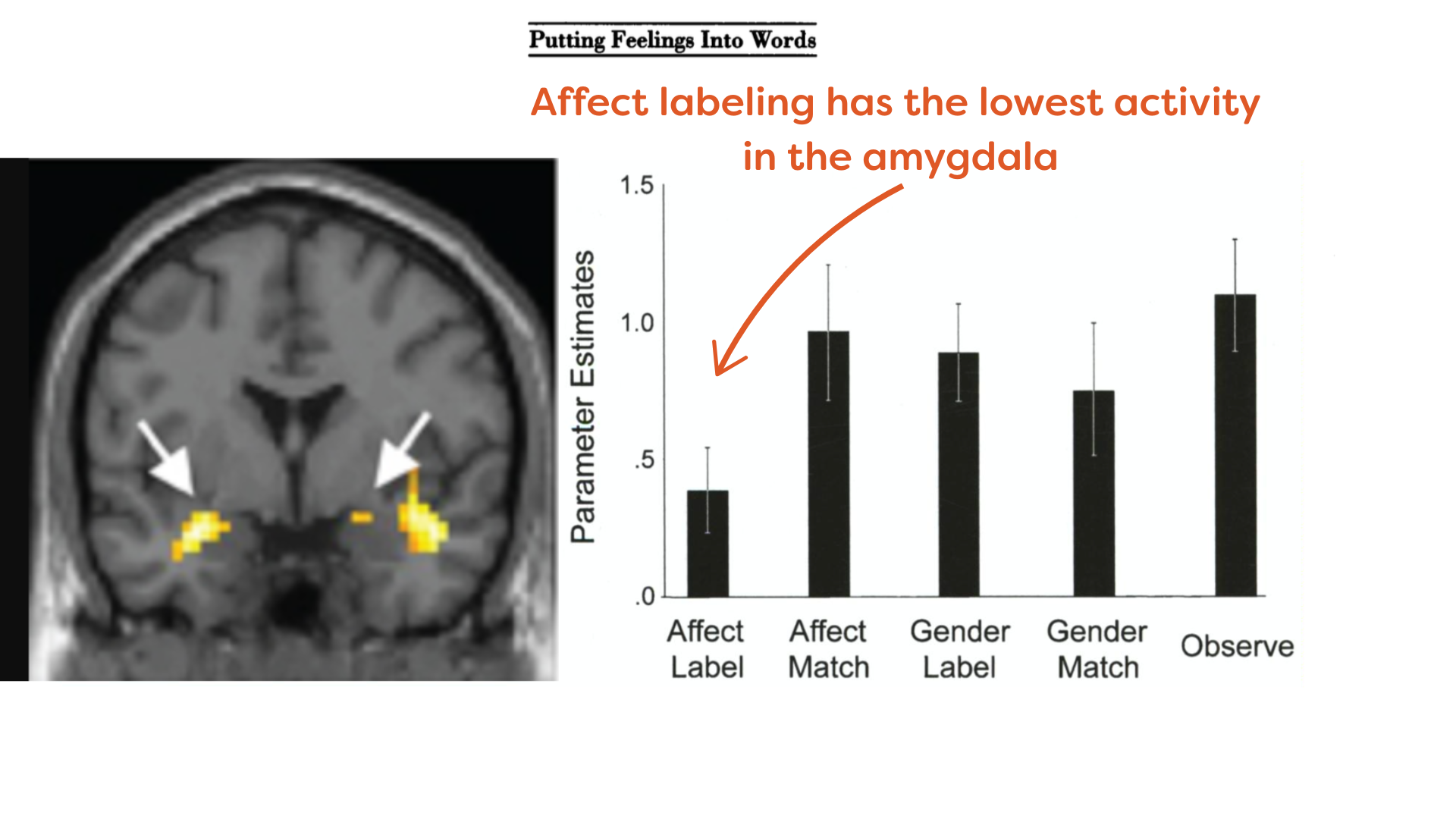
When you are in the middle of an amygdala hijack and your emotions are going wild, the fear center of your brain is on fire.
But if you do one simple thing, you will activate your prefrontal cortex and calm down your amygdala.
I'm going to share what this simple technique is, provide the scientifically proven benefits of using this technique and share 7 steps to implement this technique in the most effective way!
The Technique: Affect Labeling
Affect labeling is putting into words what emotion you are feeling.
I know this sounds very simple, but don't dismiss this idea too quickly! Keep reading, and you'll understand WHY this works and HOW to implement it most effectively!
The simple act of identifying what emotion you're feeling engages your frontal lobe—specifically, it activates your right ventral lateral prefrontal cortex (RVLPFC). You cannot put feelings into words without utilizing this part of your brain, which is involved in processing, analyzing and thinking about emotions.
The simple act of identifying what emotion you're feeling engages your frontal lobe—specifically, it activates your right ventral lateral prefrontal cortex (RVLPFC). You cannot put feelings into words without utilizing this part of your brain, which is involved in processing, analyzing and thinking about emotions.
fMRI studies show increased activity in the RVLPFC when people engage in affect labeling. The RVLPFC then communicates with the medial prefrontal cortex (MPFC), which then communicates to and calms your amygdala. The MPFC actually dampens activity in the amygdala.
Understanding the Amygdala
Most of you know that the amygdala is your sentry—the part of your brain that's always looking for danger and signaling "fire, fire, fire!"
When there actually is a threat, having an active amygdala is beneficial as it gets you moving quickly to address dangerous situations.
The problem with the amygdala in modern society is that it frequently sets off alarms when we're not in immediate physical danger. This is the part of the brain that creates the fight-flight-freeze response and intensifies all our emotions as if we were under a survival threat. [For more information on what an amygdala hijack is, read this
or watch this].
When we're in survival mode, we don't prioritize relationships, reasoning, planning, or choosing reasonable responses. We become totally reactive, which often gets us into trouble. However, by pausing and thinking through what you're feeling, you activate other regions of your brain, and your amygdala calms down.
The Science Behind Affect Labeling
Research has demonstrated the effectiveness of affect labeling. In studies, participants looked at upsetting pictures which activated their amygdala. The researchers then had different control groups perform various tasks while viewing these images. [Link to the research is here, and another research article, here].
People who labeled what emotion they felt showed much lower activity in the amygdala compared to those who performed other labeling tasks (such as identifying the gender in the picture, labeling emotions shown in the picture) or those who simply observed.
Researchers found an inverse relationship between activity in the amygdala and activity in the frontal lobe—when the prefrontal cortex was more active, the amygdala was less active.
Understanding how we can engage different parts of our brain to achieve specific emotional outcomes is powerful. There's physical evidence that what we think about changes what's happening in our brain—we can literally change which brain areas are activated based on where we direct our attention.
If you're interested in learning about how you can rewire your brain for more joy and confidence, I believe you'll be very interetsed in my free webinar "Rewire Your Brain for Joy and Confidence" that explores these concepts further.
How to Implement Affect Labeling
Let's talk about practical ways to use affect labeling in your daily life:
Step 1: Pause and reflect on what you're feeling physically and emotionally
In the middle of an amygdala hijack, pausing is essential to engage other parts of your brain. As soon as possible, take a moment to identify where and what you're feeling.
Step 2: Be specific about the emotion you're naming
It's very helpful to use an emotion chart (many are available online). Don't just say, "I feel bad." How exactly do you feel bad? Even "anger" can be too general—is it frustration or rage?
Also, try to identify if there's another emotion underneath the obvious one. If you feel angerm, see if you actually feel hurt or sadness, deeper than the anger. If you feel anxiety, investigate is it a feeling of powerlessness? Or irritation? Perhaps there may also be a sadness that you'd prefer to ignore! We often feel multiple emotions simultaneously - which can make things complicated, leading to Step #3:
Step 3: Don't worry if you can't immediately identify your emotion
Many people don't know exactly what they're feeling and then become anxious about that uncertainty, leading to self-criticism. It's completely fine to say, "I'm not sure what I'm feeling. Perhaps it is... [fill in some options]."
Take time to elaborate on your emotional state. Whether you verbalize these thoughts aloud (preferable) or just in your head, using words engages different parts of your brain.
Step 4: Be patient with yourself as you develop emotional awareness
It takes time to develop awareness and understanding of our emotions. Allow yourself to practice. Expanding your emotional vocabulary has been linked to better mental wellbeing, so it's worth investing time in this skill.
Step 5: Observe your emotions non-judgmentally
Don't criticize yourself with thoughts like, "I always do this!"
Just observe.
If you're angry, avoid telling yourself, "I shouldn't be angry."
It's okay to feel whatever you're feeling—what matters is the behavior that follows.
It's okay to feel whatever you're feeling—what matters is the behavior that follows.
This entire process is about slowing down and calming down so you can choose your actions rather than simply reacting. Your feelings are separate from the behaviors that often follow them.
Step 6: Combine affect labeling with physiologically relaxing techniques
While not mentioned in the research I referenced, I believe it's beneficial to combine naming your emotions with activities that are physiologically relaxing. This could be taking a deep diaphragmatic breath, going for a slow walk in nature, or petting your dog or cat while you identify your emotions.
Step 7: Notice the effects and practice regularly
As you practice affect labeling, pay attention to whether it calms you down and shifts your thinking and feeling.
Importantly, practice this technique when you're not in the middle of an amygdala hijack. On an ordinary day, check in with yourself—"I'm feeling okay, but what specifically does 'okay' mean for me right now?" Use an emotion chart to identify precisely what you're feeling.
The Benefits of Affect Labeling
To summarize, here are the key scientifically proven benefits of affect labeling:
- Reduces the intensity of negative emotions
- Helps you regain control during difficult emotional situations
- Allows for more thoughtful responses in what you say and do
- Improves your emotional intelligence and awareness
- Enhances overall mental wellbeing
You DO have the ability to calm your amygdala, reduce your reactivity, and regulate your emotions—and this process will get easier with practice!
I'd love to hear your thoughts on affect labeling. Has this technique worked for you? Do you have questions about implementing it in your life? Share your experiences in the comments below!
Blog Author: Barbara Heffernan, LCSW, MBA. Barbara is a licensed psychotherapist and specialist in anxiety, trauma, and healthy boundaries. She had a private practice in Connecticut for twenty years before starting her popular YouTube channel designed to help people around the world live a more joyful life. Barbara has a BA from Yale University, an MBA from Columbia University and an MSW from SCSU. More info on Barbara can be found on her bio page.
Share this with someone who can benefit from this blog!

Anticipatory anxiety shuts down our creative problem-solving, just when we need it the most. Here's the process to get it back. 4 steps to help anticipatory anxiety.
"Just stop thinking about it" doesn't work. However, the Attention Training Technique from Metacognitive Therapy has been shown to help lower anxiety and rumination.
Does your brain drive you nuts going over and over the same thing—the mistake you made, the difficult conversation you had....anything you are worried about? This is rumination and it is driven by the Default Mode Network of the brain. Understanding this can help you change.

Social anxiety often has a trauma root — understanding the connection can help you heal.
Overloaded and Overwhelmed? You are in the right place. Here's help.

overwhelm has a cruel side effect. It shuts us down. Right when we feel like we need to get more done, not less, overwhelm makes our mind go blank or puts us into a freeze stateUnderstanding how overwhelm manifests for you can really help you calm it down.
Terrified to make eye contact? Constantly worried about what others think of you? You're not alone. These experiences are fairly common and often point to social anxiety disorder, which IS treatable. This blog explains this connection, provides treatment options and 3 self-help tools.
Interoceptive exposure can be transformative for people with somatic anxiety, specifically panic attacks, PTSD, OCD and health anxiety. Interoceptive exposure is a technique used within CBT, Cognitive Behavioral Therapy.
If you view your emotions as something to be avoided, squashed or feared — you are activating your your amygdala, and setting off internal alarm bells. This makes everything worse. Research has shown there are six beliefs that drive emotional dysregulation. Which one is yours?
Emotional distress : its intensity and duration is driven by certain beliefs. Learn 3 tools to help regulate your emotions. This has substantial research behind it – and an expert explains.
