2 Questions to Calm Anxiety

Anxiety Wants to Convince You That You Need It!
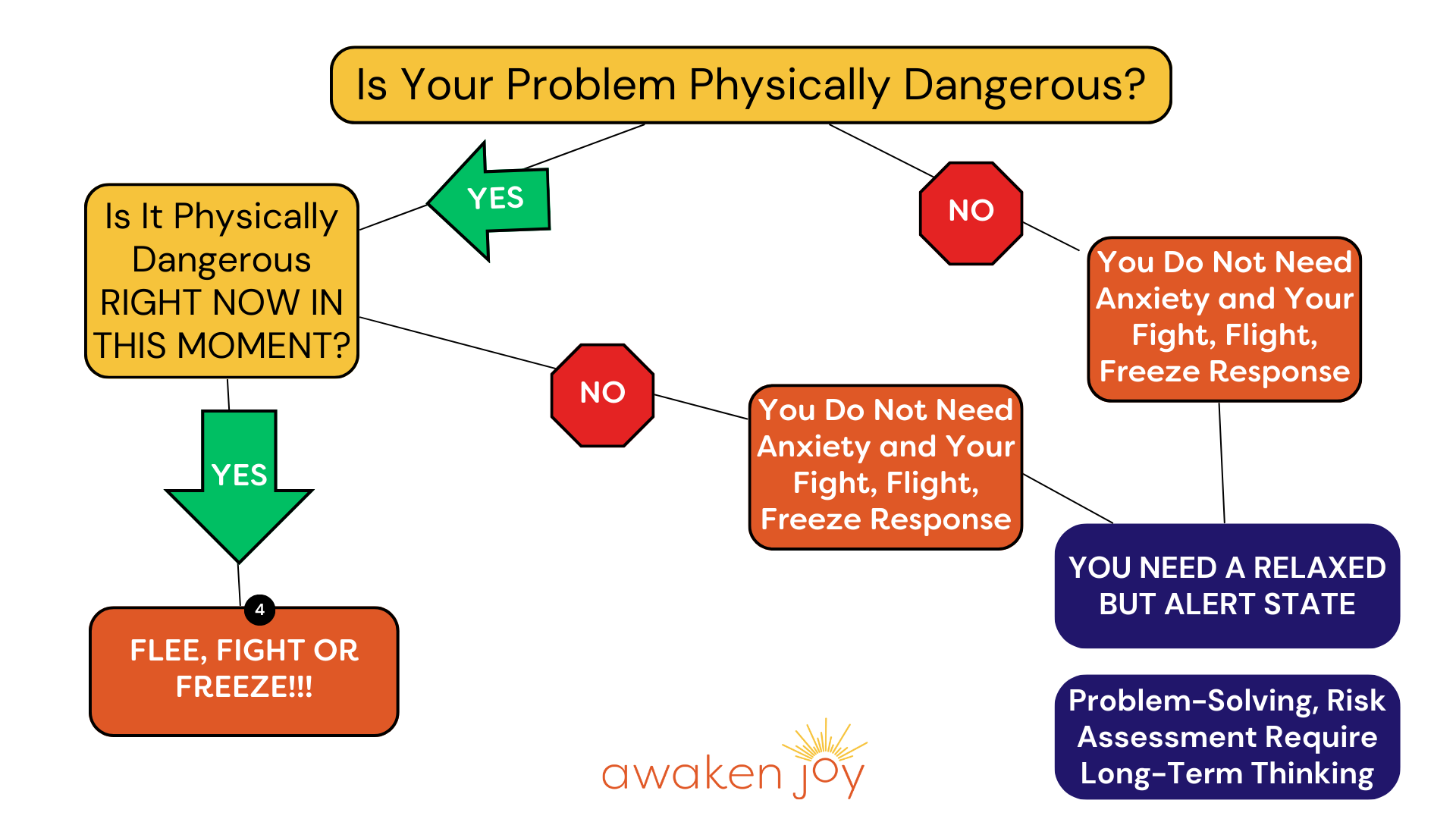
These two questions will help you decide if you actually need it or not.
Over twenty years of helping people with their anxiety as a psychotherapist, I saw that a primary reason people could not overcome anxiety is that they believed that they needed it!
“Doesn’t this problem require anxiety?,” they would say.
If you ask yourself these two questions with everything you're anxious about and really think it through, the answer leads you directly to what you should do.
Question #1:
Is the situation I'm worrying about actually physically dangerous?
Right now, this problem, is it dangerous for you?
If the answer is no, that leads to a very clear answer, which is that you don't need the fight, flight, freeze chemicals that your body is generating.
Now, I know it's not always super easy to calm that chemical reaction down, but this is where you begin to implement some somatic or behavioral changes that help your body begin to feel safe, right now, here in this moment.
The answer of “no” to this question also leads to another conclusion, which is that the problem you are facing needs a different kind of problem solving. We can have serious problems and it may be the norm to respond to these types of problems with anxiety. But if the problem isn’t physically dangerous, it needs longer term thinking.
Our anxiety treats everything like an urgent, dangerous, short-term problem.
Our brains think best when we are in a relaxed but alert state. This is where we problem-solve the best. This is where we have adequate risk assessment and can think through problems.
Our anxiety always wants to tell us it's necessary. We can get stuck in thinking that we really do need to overthink, overanalyze and feel anxious about a problem.
So, we actually have to disconnect from the anxiety, using our observer brain. If we step back from our anxiety, we can say to ourselves “OK, this is a real problem, not denying it's a real problem, but it's not one that requires anxiety. It's one that requires attention. Maybe some time, maybe some investigation, maybe some feedback from others or counseling. It is a problem, but it doesn't require the fight, flight, freeze response so it doesn’t require anxiety.”
Question #2:
So if your answer to the question above is “Yes, this is dangerous,” then the second question to answer is: “Is it dangerous right now to you in this moment?”
If the answer is yes, you should not be reading this blog!
If the answer is yes, you should be fleeing, fighting, or freezing.
Our fight, flight, freeze response is needed and necessary in an emergency. This response is driven by our amygdala. It's an old part of our brain. It doesn't have higher level thinking skills. It's not connected to sophisticated risk assessment.
It's an immediate, quick reaction that senses danger and wants you to fight, flee, or freeze.
So if your problem is dangerous, right now at this very instant, this very instant, you need to flee, fight or freeze.
But if it's not dangerous this very instant, you don't need the anxiety chemicals.
Because even if it is a serious, potentially dangerous problem, if it's not happening right now to you in this moment, it again requires longer term thinking, risk assessment, and planning. All of those utilize completely different areas of the brain.
When our amygdala is firing, warning, warning, danger, danger, danger, it's taking all of our energy and it co-ops the entire brain. It does actually co-opt your frontal lobe so that your thoughts will spin with that anxiety. Your thoughts might think they are in charge at that moment, but they are not.
Your thoughts will buy in to the amygdala’s panic. Your thoughts will say, “Oh yes, we need to worry about this! How could we let it go? Of course, I need to keep thinking until I find a solution!” That is how our anxiety convinces us fully that we need it. That can block anxiety recovery.
Because if something is not immediately dangerous, the most productive thing we can do is to calm the anxiety response down. I find physiologically calming techniques the most helpful, but our thinking may not let us do this unless we put this logical question into our brain. This is what will convince us that we do
not need this anxious response.
I talk about this more in my free, online webinar
Rewire Your Brain for Joy and Confidence. You can schedule to attend by clicking
this link.
And let me know your thoughts!
Blog Author: Barbara Heffernan, LCSW, MBA. Barbara is a licensed psychotherapist and specialist in anxiety, trauma, and healthy boundaries. She had a private practice in Connecticut for twenty years before starting her popular YouTube channel designed to help people around the world live a more joyful life. Barbara has a BA from Yale University, an MBA from Columbia University and an MSW from SCSU. More info on Barbara can be found on her bio page.
Share this with someone who can benefit from this blog!