Anxious About a Decision? 5 Concepts to Help!

Do you struggle with making decisions?
Are you frustrated with your indecisiveness?
Maybe you're grappling with big decisions about your job, career, or marriage. Or maybe you struggle with all decisions, including small ones like what to wear or where to go for lunch. Wherever you fall on the spectrum, the indecisiveness is probably due to anxiety.
If you have anxiety, it's common to struggle with decision-making. Even if you don't identify as anxious, it's worth considering that anxiety might be influencing your indecisiveness. Many people who don't think of themselves as anxious still experience significant anxiety without realizing it.
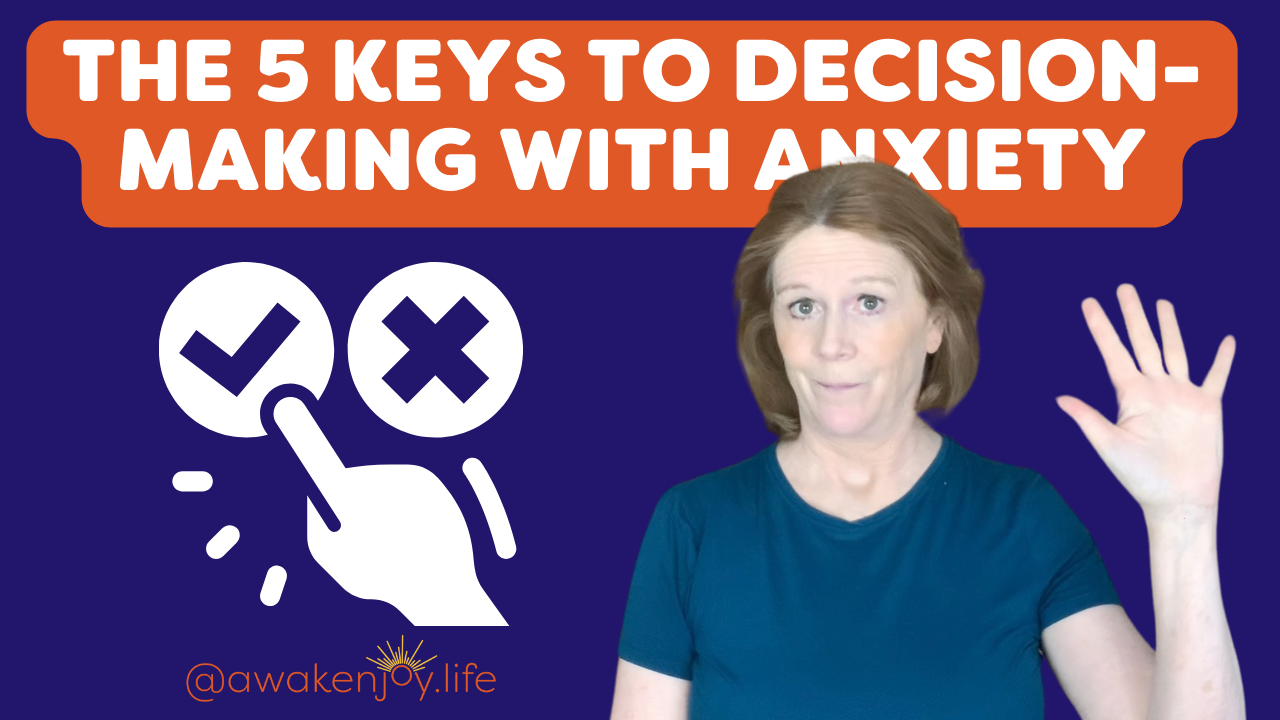
Through my 20 years as a psychotherapist specializing in anxiety and trauma, I learned on a very deep level why people have trouble making decisions. Today, I’ll share the five factors underlying anxiety in decision-making.
#1: Life is uncertain.
I understand that hearing this can be unsettling, but it's a fundamental truth. Both individually and societally, we push away the idea of uncertainty, thinking that making the right decisions can control the future and ensure a happy ending. However, accepting uncertainty can actually alleviate anxiety. Embracing the fact that life is unpredictable can reduce the pressure to make the "right" decision.
#2: We want to control the uncontrollable.
Anxiety often stems from trying to control what we are powerless over. Productive worry leads to actions we can take, like studying for an exam in order to do well.
Productive worry could come up if you have a job you don't really like. You might say to yourself, “Hmm, this doesn't seem to be going in the right direction for me or the company I’m working for. I think I’ll update my resume and start sending it out.” That is identifying a problem and taking steps to solve it.
But, if instead of that thinking, you begin to worry that the company isn't doing well, and focus on, “What if the company fails and they lay everybody off," what you're spending your time thinking about and worrying about, is not within your control. And that's anxiety.
Our anxiety about decision-making often comes from a desire for a guaranteed happy ending. Instead, we should focus on making the best choice with the information we have now.
#3: Value Conflicts.
When our values conflict, decision-making becomes challenging. For example, you might value earning a good living but also value family time, leading to a conflict if your job requires long hours. Recognizing these value conflicts can help you prioritize what’s truly important to you.
#4: Is Sitting on the Fence Comfortable For You?
I know sitting on a fence isn't comfortable, but some of us do it a long time. I am definitely guilty of this!
I've realized that we must get SOME benefit out of it - or why would we do it?
I've realized that we may prefer the discomfort of indecision over the risk of making a wrong decision.
Or maybe we prefer this discomfort over making a
real commitment that's going to require action and uncertainty.
That brings us back to that uncertainty thing. So sitting on that fence means you don't have to really accept that uncertainty. You don't have to take a risk. And this also ties to loss aversion. The human brain is more averse to losing something than gaining something.
So, there are times when it makes sense to sit on the fence. The time isn't right for a decision, or you need additional information. But often, the fence-sitting leads to analysis paralysis, where we overthink and ruminate without making progress.
Constant rumination is exhausting. If you’re plagued by indecision, it can consume your mental energy and disturb your sleep. Sometimes, the best way to break out of this cycle is just to make a decision and move forward, trusting in your ability to adapt.
#5 The Myth of a Perfect Decision.
Underlying all these difficulties is the mistaken belief in a perfect decision. Life is unpredictable, and the paths we choose often lead to unexpected places. Knowing yourself, understanding your values, and being comfortable with uncertainty can help you make better, quicker decisions.
If you struggle with anxiety and indecision, my free webinar "Rewire Your Brain for Joy and Confidence" might be helpful. It explores how innate brain qualities and societal expectations shape our thinking and behaviors, AND it offers strategies to change these patterns.
Remember, there's no perfect decision. Each choice brings its own set of outcomes, some desirable and some less so. Accepting this reality can make decision-making less daunting. I’d love to hear your thoughts on this. If you found this helpful, please share it with someone who might benefit. And I'd love to hear your comments (can post below)!
In case you missed these, you might find one of these blogs useful:
Why People-Pleasers Have Trouble Making Decisions
Is It My Intuition or My Anxiety?
Blog Author: Barbara Heffernan, LCSW, MBA. Barbara is a licensed psychotherapist and specialist in anxiety, trauma, and healthy boundaries. She had a private practice in Connecticut for twenty years before starting her popular YouTube channel designed to help people around the world live a more joyful life. Barbara has a BA from Yale University, an MBA from Columbia University and an MSW from SCSU. More info on Barbara can be found on her bio page.
Share this with someone who can benefit from this blog!