Anxiety: The RIGHT Use of Logic

Barbara Heffernan • February 27, 2026

Can You Think Your Way Out of Anxiety? Why Logic Often Backfires (And What Actually Works)
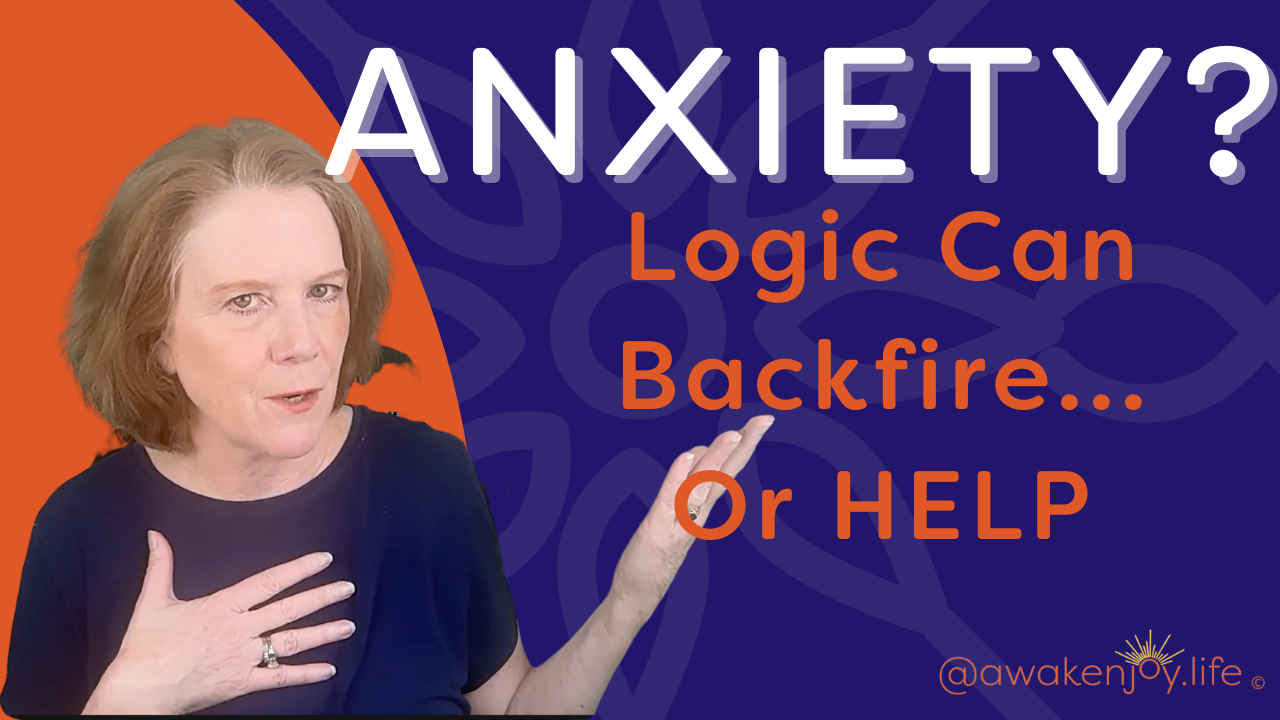
Have you ever found yourself in the middle of an anxiety spiral, frantically trying to talk yourself out of it with logic? 
  • "The odds are so low this will happen." 
  • "I'm being irrational." 
  • "There's no real reason to worry about this." 

You might even have well-meaning friends or a therapist who try to use the same approach, attempting to convince you that the threat is not real.

Here is the problem: this kind of logic usually backfires. 

In fact, it can make your anxiety worse.

Why? Because this approach is problem dismissal, not problem classification. And your anxious brain knows the difference.

The good news is that you can use your rational brain to help with anxiety—you just need to ask it the right questions.

The Right Question to Ask Your Rational Brain

Instead of trying to convince yourself that your anxiety is irrational or unfounded, ask yourself this:
"What does this situation call for from me?"

In other words: What does this situation need? What is required to solve the problem?

This question shifts your focus from dismissing your feelings to accurately classifying what you are experiencing and what action (if any) is actually needed. To help you answer this central question, there are four sub-questions that will guide your rational brain to work with you rather than against you.

Sub-Question #1: Are the Fight-Flight-Freeze Chemicals I'm Experiencing Necessary for This Problem?

Our amygdala—our survival mechanism, our fight-flight-freeze system—is a brilliant system for survival in the face of immediate danger. Think: saber-tooth tiger chasing you. 

Your survival mechanism is designed to help you react instantly when your life is at stake.

However, it is not a brilliant system for a difficult conversation, giving an important presentation, or waiting for a medical result. In those situations, we do not need our fight-flight-freeze response. We need our full brain online for problem-solving.

The use of logic here is to recognize: "Okay, all these chemicals flooding my system are not really helpful right now." That recognition leads you to say, "I need to engage in diaphragmatic breathing and somatic relaxation to calm these chemicals down."

Your rational brain can identify the mismatch between the situation at hand and your body's chemical response to it. It is not dismissing the problem—it is simply recognizing that a survival response will not solve it. But if you do not engage that rational brain to make this distinction, you probably will not take the steps to calm your nervous system.

Sub-Question #2: Is My Anxiety Actually Caused by This Problem, or Is It Caused by the Fact That I Have Anxiety?

This question focuses on problem classification. How do you know if you are anxious because you have a real problem, or simply because you have anxiety?

Here is how you can tell: If you tend to worry about, say, three problems, and then two of them go away, and suddenly you find yourself worrying about other things, then the problem is the anxiety itself.

If the things your anxiety attaches to can be in any area of your life — something happening in the world, or to your friends or family members or your work or dating life — then you likely have generalized anxiety disorder GAD. If the things your anxiety attaches to always fall into one category (like health concerns), you may have health anxiety. If it is a cycle of obsessions and compulsions, it is OCD.

People with OCD are usually very aware that their anxiety is irrational—they already have this question answered. But most people I have met with substantial health anxiety will say, "But I have to worry about my health. How could you not worry about it? This is something to worry about."

But if you find that yes, you are worried about this problem, and then that one goes away and you have another, and then another—the problem is the anxiety itself.

Identifying this helps because it leads you to ask: "What is the actual solution for the kind of anxiety that I have? How do I somatically calm this anxiety and not buy into it?" Buying into it means going over and over the problem, looking for a solution that is not addressing the real issue.

Sub-Question #3: Is My Anxiety Actually Covering Up Some Deeper Emotions That Need to Be Felt?

This can be a really challenging question for people. However, if you experience anxiety often, it is probably a cover-up emotion.

You do not want to feel sadness or grief, so you feel anxious instead. 

Maybe you really dislike being angry at somebody. So instead of getting angry, you become anxious about the situation. Did you say the wrong thing? What should you say? How do you address it? You go over and over it with anxiety when at your core you are angry, or at your core you are really sad, or at your core you feel powerless. That is an emotion none of us like to feel.

Sometimes the actual solution to anxiety is to sit with those difficult underlying emotions. Acknowledging them and labeling them is scientifically proven to lower your anxiety. 

Most of us do not think of our rational brain as being the part of us that is going to say, "You know what, it is really good to just sit and feel this feeling." It is somewhat counterintuitive that your problem-solving brain is not going to be problem-solving—it is going to be saying, "Just sit and feel it." But your rational brain can help you do that.

Knowing that what you are experiencing is not a threat to be denied and not a threat to be neutralized—it is actually an emotion that needs to be felt—is crucial information from your rational mind. (But keep in mind - the emotion that needs to be felt is not anxiety! It is the one under it.)

Sub-Question #4: What Do I Need to Do to Get the Best Outcome Here?

This is where we utilize the full brain to problem-solve. Your rational brain can help you identify what is within your control and what is not within your control.

Almost all excessive anxiety is about the things we cannot control. But going through it step by step enables you to say, "Okay, what is within my control to help me get the best outcome possible from this difficult conversation I am going to have, or from this medical procedure I have to go through, or this presentation I have to give?"

Sometimes the problems are even larger. But no matter what, there is a part of the problem that you have agency over, and there is a part of the problem that is outside of your control.

For most people, we really dislike those things that are out of our control. Many of us have a really hard time admitting anything is outside of our control. Admitting things are outside your control can bring you back to those difficult emotions—sadness, grief, uncertainty.

But here is something that might sound counterintuitive: the acceptance of uncertainty is actually core to recovering from anxiety. The acceptance that life is uncertain is fundamental. We have to accept that some things are outside of our control, and all we can do is focus on the things within our control so we get the best possible outcome.

Bringing It All Together

This brings us back to the right question to ask: "What does this situation call for from me?"

Make sure to use your rational brain not to dismiss the problem you are having, and not to negate the feelings you are having, but to accurately classify the feelings you are having and accurately classify the problem you are facing.

Sometimes that problem might simply be: "I do not want to accept the uncertainty that life has in it." But at least then you have identified the real problem.

Final Thoughts

I know I did not go into extensive detail about solutions for each different anxiety disorder in this post. My purpose today was to help you incorporate logic in a way that is not going to backfire and is going to help move you forward.

For more solution based blogs try these: CBT Tools for AnxietyCalm Amygdala Hijack.

I am very curious what you think. Please share your thoughts in the comments. Let me know if this approach resonates with you or if you have questions.

Blog Author: Barbara Heffernan, LCSW, MBA. Barbara is a licensed psychotherapist and specialist in anxiety, trauma, and healthy boundaries. She had a private practice in Connecticut for twenty years before starting her popular YouTube channel designed to help people around the world live a more joyful life. Barbara has a BA from Yale University, an MBA from Columbia University and an MSW from SCSU.  More info on Barbara can be found on her bio page.

Share this with someone who can benefit from this blog!
By Barbara Heffernan July 12, 2026
 Social Anxiety Often Has a Trauma Root — Understanding the Connection Can Help You Heal
By Barbara Heffernan July 9, 2026
Overloaded and Overwhelmed? You are in the right place. Here's help.
By Barbara Heffernan June 26, 2026
overwhelm has a cruel side effect. It shuts us down. Right when we feel like we need to get more done, not less, overwhelm makes our mind go blank or puts us into a freeze stateUnderstanding how overwhelm manifests for you can really help you calm it down.
By Barbara Heffernan June 12, 2026
Terrified to make eye contact? Constantly worried about what others think of you? You're not alone. These experiences are fairly common and often point to social anxiety disorder, which IS treatable. This blog explains this connection, provides treatment options and 3 self-help tools.
By Barbara Heffernan June 4, 2026
Interoceptive exposure can be transformative for people with somatic anxiety, specifically panic attacks, PTSD, OCD and health anxiety. Interoceptive exposure is a technique used within CBT, Cognitive Behavioral Therapy.
By Barbara Heffernan May 29, 2026
If you view your emotions as something to be avoided, squashed or feared — you are activating your your amygdala, and setting off internal alarm bells. This makes everything worse. Research has shown there are six beliefs that drive emotional dysregulation. Which one is yours?
By Barbara Heffernan May 18, 2026
Emotional distress : its intensity and duration is driven by certain beliefs. Learn 3 tools to help regulate your emotions. This has substantial research behind it – and an expert explains.
By Barbara Heffernan April 23, 2026
The main thing that drives rumination is actually the BELIEFS we have about the FEELINGS that come up from a difficult situation. Rumination is driven by the habitual patterns of thinking combined with our judgments about whether we can handle the emotions, both of which can be changed to experience relief.
By Barbara Heffernan April 3, 2026
You can probably recall a time when you were with someone who was intensely anxious—and within minutes, you began to feel anxious yourself. Perhaps your heart rate increased. Your breathing became shallow. The knot in your stomach tightened. Or maybe you remember the opposite: a time when you were with someone who was truly grounded and calm, and their presence actually calmed you down. Your shoulders dropped. Your breathing deepened. The tension you had been carrying began to dissipate. This is not your imagination. This is emotional contagion, and it is scientifically proven. Understanding how your own emotional regulation—or lack thereof—impacts other people, and how other people's emotional states impact you, is essential for healthy relationships. Learning emotional regulation tools can improve your relationships significantly. Learning how to lower your susceptibility to emotional contagion can help as well. In this article, I will explain what emotional contagion is, how it impacts relationships, and provide five specific strategies for improving regulation in your own relationships. What Is Emotional Contagion? Emotions are contagious. Extensive research—both behavioral research and neuroscience—shows that we pick up the emotions of the people around us. The closer our relationship with them and the more invested we are in that relationship, the more this phenomenon occurs. This may not always feel accurate because we also tend to balance each other out. If someone is very upset, we might suppress our own emotions in response. But as I will explain, that suppression is actually part of the same dynamic. Three Pathways to Emotional Contagion There are three pathways that lead to emotional contagion: Pathway 1: Automatic Mimicry Unconsciously, when we see facial expressions in another person, we mimic them. If someone smiles, we tend to smile immediately. If someone frowns, we might make the same expression. This happens not just with facial expressions but also with voice, tone and body posture. Pathway 2: Autonomic Mimicry This involves our autonomic physiological system which works in synchrony with other people. Our heart rate, our breathing rhythm, and even our pupil dilation tend to mimic each other. Our nervous systems influence each other constantly. Pathway 3: Affective Convergence This is the convergence of feelings. When our facial expressions and body posture mimic another person's, and our physiological system aligns with theirs, we develop the same affective feelings. We end up experiencing a version of that emotion ourselves. The Suppression Trap: Why "Staying Calm" Can Make Things Worse If someone is extremely upset, you might calm way down. If this happens almost automatically, you are probably suppressing your emotions rather than regulating them. Extensive research shows that when one person suppresses their emotions, it actually makes the other person more anxious. And the person who is suppressing—while they might appear calm externally - is experiencing all the physiological signs and symptoms of anxiety or a heightened emotional state. Even when we are trying to be the balance in the room, we might actually be escalating the emotions present. This is particularly true for those who grew up parentified. Adults who were parentified as children often feel their emotional regulation is better than anyone else's in their families. While that might be true to some extent, without substantial self-awareness and genuine emotional regulation tools, you are likely using emotional suppression, not regulation. Where Emotional Regulation Patterns Come From The means by which you emotionally regulate—and whether you are highly regulated or highly dysregulated—is largely due to how you were raised. I am not saying this to assign blame, nor do I want you to spiral into worry about what you may have done to your own children. These are intergenerational patterns, and all we can do is work with the present. However, it can help to recognize that if you feel your own emotional regulation is lacking, you probably learned from dysregulated caregivers. If you have a partner who is very dysregulated, the same is likely true for them. This understanding allows us to remove blame and accusation from the discussion. We can approach this with compassion, recognizing that these are skills that should perhaps be taught in school or more seriously in our society—but they are not. The good news is that you can learn them now. Five Practical Tools to Improve Emotional Regulation in Your Relationships It truly is possible to improve your own emotional regulation and have a postiive impact on your relationships. These tools are helpful even for the partner that feels they are the one who is more emotionally regulated. And as a heads up, Tools 1 and 5 require substantial work - but gradual improvement is helpful! Tools 2, 3, and 4 are easier to implement immediately. Tool 1: Develop Your Emotional Boundaries Because emotional contagion is so strong—particularly if you grew up in a caretaker role in your family—it is important to begin recognizing when the emotions you are feeling are the ones you are absorbing from someone else. Begin to visualize a see-through bubble around you which represents you and your emotional boundary. Begin to think of your emotions as existing within that bubble. And picture another bubble around the other person - give it a light, see-through color. Picture that all their emotions are within their bubble. Differentiate between what you are feeling and what they are feeling. Bring in your observer brain to look at what you are feeling. For example... "Wait a second. I am feeling anxious because my partner is anxious about their interview tomorrow. What is my anxiety about?" You can begin to see whether your anxiety is about getting them to calm down so they can perform well in their interview. Perhaps you don't want them to be disappointed, or you have a vested interest in them getting a job. Once you understand why you are feeling anxious, you can apply tools to reduce your own anxiety, rather than focus on theirs. Because if we get anxious about making sure someone else is not anxious, it simply escalates the anxiety in the room. Part of developing emotional boundaries is understanding that other people's emotions are not ours to solve. We can be empathetic without feeling responsible for calming the other person down or changing their emotional state. Your observer brain can help you think through, "I do not have to convince them. I can recognize the impact their emotional state has on me, but I do not have to spiral into desperately trying to fix something I cannot fix." Tool 2: Use Your Breathing Deliberately If you learn diaphragmatic breathing and use it during difficult moments in relationships, you can keep your physiology within a tolerable range. In EMDR therapy, there is a concept of keeping your emotions within a "window of tolerance." They can still fluctuate, but you remain relatively regulated throughout. Diaphragmatic breathing is a powerful way to help yourself do that. When you breathe in a calm, regular manner, it is actually helpful to the other person as well. Your regulated physiology can support theirs. Tool 3: Establish a Guideline for Taking Breaks Put in place for yourself a boundary about taking a break from a conversation if you become too emotionally dysregulated. What typically happens in couple relationships (and I saw this extensively during 20 years of couples counseling) is that one person is visibly out of control upset, and the other says, "We need to take a break until you calm down" (and there's usually a finger point that goes along with the "you"). Generally, this escalates the emotions in the room. In actuality, even if you are the one who appears less upset externally, you are probably very physiologically activated internally. There is a marriage and family therapist and researcher who has a rule: if your pulse rate is 10% above its normal resting rate ), you need to take a break. ( John Gottman, PhD, Seven Principles for Making Marriage Work ) The problem with telling the other person they need a break to calm down is that it will make things worse. It feels like criticism and attack. It makes someone defensive. It increases their fight-flight-freeze response. Instead, say: "I am having a hard time regulating myself in this moment. Can we take a 10-minute break? I will be right back. I just need 10 minutes to do some slow breathing. We can set our alarm." You must put a time frame on it. Take a five-minute break, a 10-minute break, or if you are extremely dysregulated, revisit the conversation in the morning. Without a time frame, the other person will feel abandoned, which escalates their emotional dysregulation. You may also be feeding into your flight mode—your reactive pattern of running away from conflict. Set the boundary for yourself, not for the other person: "If I get too upset, I will take a mini timeout to calm myself down." I recognize this does not work in every situation. You cannot simply walk away from a young child. But you can incorporate this thinking to develop creative strategies of your own. Tool 4: Validate Before You Fix or Problem-Solve One of the most regulating things you can do for someone else is help them feel truly heard. Acknowledging their emotional experience before moving to "let's fix this and problem-solve" will de-escalate their emotional response and prevent the conversation from escalating out of control. I know I said you are not in charge of their emotional regulation—and you are not. However, knowing strategies that benefit the relationship benefits you. These are basic relational tools. If you have a partner who has difficulty validating your emotions, and you are emotionally regulated, you can say: "I am very upset about this, but I do not want to jump into problem-solving. I simply want to feel heard." There is an element where we sometimes have to help train people how to be in relationship with us. If you are in couples counseling with a therapist facilitating this, excellent. But if you are not, sometimes it helps to explain these concepts to your partner. Let them know what will help you calm down when you are upset. You might have to remind them, and I know that takes substantial emotional regulation on your part. But honestly, that is the big picture here: the best thing you can do for your relationships with others—as well as your relationship with yourself—is learn emotional regulation tools. Tool 5: Practice Honest, Regulated Communication This can be understood as assertive communication that is also compassionate. If you are feeling overwhelmed, I understand. These concepts can seem complex and somewhat unattainable. I have an online boundary program that addresses emotional regulation as the foundation for healthy boundaries. It includes an exercise on visualizing emotional boundaries to strengthen that skill, and an entire section on assertive communication so you can set and maintain boundaries. Healthy boundaries are not about keeping people away or controlling other people's behavior. Healthy relationships actually require good boundaries. Good boundaries are about knowing yourself—where you end and the other person begins—and knowing it is acceptable for you to have needs. Compassionate, assertive expression of whatever needs to be communicated will help the relationship. It can be done in a way that supports your own emotional regulation and possibly helps the other person—or at minimum, does not contribute to escalation. Suppressing your own emotions and needs will escalate the negative cycle of conversation. This is not about suppression. It is definitely not about lashing out, exploding, or releasing everything you have been suppressing because you are angry and frustrated. If you have taken that timeout when needed, if you have been aware ("my heart rate is way up; I am in fight-flight-freeze mode"), you will not reach that explosion point because you will have taken your break and calmed down. All these steps are interrelated. Expressing what you feel in a regulated manner keeps you in connection with the other person. Remember: it is not just what you say but how you say it, and even how you are feeling when you say it. A statement like "I am feeling overwhelmed right now with too much to do" will enable you to stay in connection far more effectively than exploding because your partner has not done what they were supposed to do. Anytime we explode with attack or criticism, we contribute to emotional dysregulation in the room. Bringing It All Together Consciously keep track of your own emotional regulation Visualize your emotional boundary Use breathing techniques to stay within your window of tolerance, aware that you might need to take a mini timeout for yourself if you cannot stay within that window Validate the other person's feelings, emotions, and experience. Pay attention to: "This is me and my emotions, and that is them and theirs." Practice assertive communication which includes compassion for yourself and the other person This is not easy work. I know that. But what I want you to understand is that emotional contagion is real, and there are tools you can use to work with it. You can understand the other person without fully absorbing their emotional state. We are not individual emotional islands. Each one of us impacts those around us. Let me be very clear: Impacting others is not the same as causing their emotions or being responsible for their emotions. They are not responsible for ours. We are responsible for our own emotions and what we do with them. Yet there is this framework of interconnectedness among us, and knowing how to work with it can improve your life and your relationships significantly. Please share in the comments if you found this valuable. What resonated with you? What questions do you have?
By Barbara Heffernan March 26, 2026
Said yes but regret it? This blog provides scripts for How to Say NO After You Said YES. You can change your answer gracefully and stop people-pleasing.