
Dysfunctional Family Roles During the Holidays
Barbara Heffernan • November 26, 2025

Have you ever noticed that when you go home for the holidays, you suddenly revert to old patterns?
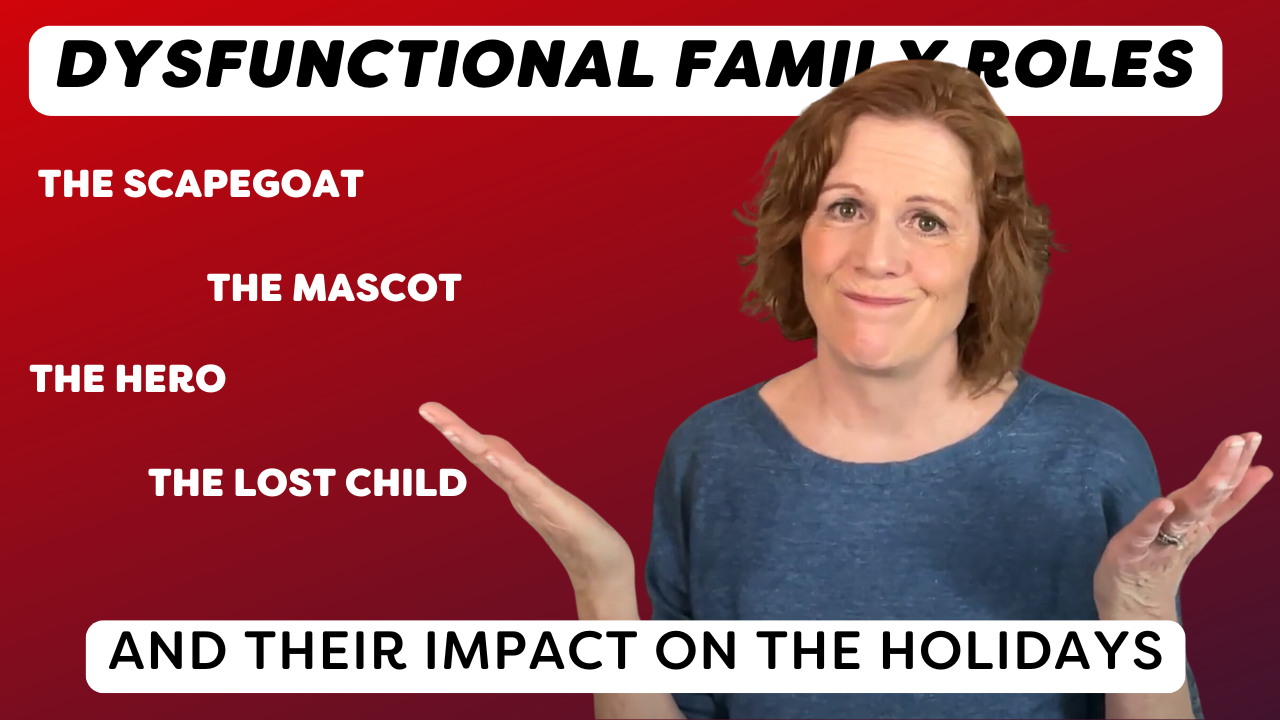
You've left your family of origin, done personal growth work, and become a much more well-rounded person.
Suggestions:
Prior to your family gathering, you can identify one or two behaviors that you would like to change and set a boundary for yourself.
This boundary is not dependent on anyone else - it is dependent on you changing how you respond to everyone else who is probably doing what they always do!
Be compassionate with yourself. Breaking these patterns is SO hard! Be gentle and understanding if you slip back.
Try to have compassion for your family... know that they developed their role as a way to cope with the same problem. And for your parents - they grew up in their own families of origin and may have suffered in ways no one is aware of. This does not mean you have to accept unacceptable behavior!! Just know that judging often leads to more isolation and to resentment.
I wish you peace and joy this holiday season!
You mostly feel good about yourself., or maybe you even feel really good about yourself!
Yet when you go home for the holidays, it seems you turn right back into your old role!
Yet when you go home for the holidays, it seems you turn right back into your old role!
It's like a time machine because you suddenly begin to react the way you would have when you were much younger. You remind yourself of your 7, 10 or 14 year-old self and you think, "How could I be acting this way?"
Today's blog will give you a quick rundown of how these family roles typically present during family events and holidays.
The Hero Child or Caretaker
The hero child or caretaker is usually the one cooking all the food, cleaning up, arranging the events, even coordinating how other family members get there.
If this is you, you probably make sure you're buying gifts for everybody. You might even buy gifts for that relative who never buys gifts for others so that person has something to give. You might be doing everything for everybody because that's always been your role within your family system.
What does it lead to? Exhaustion, irritability, resentment, stress, and even loneliness. Because even with all the effort you've put in, you're not getting the feeling you're looking for. You're not getting a return on that effort. And the resentment you feel is toxic for you.
Resentment is like taking poison but hoping it hurts the other person. It's a toxic emotion to feel, and it often signals that we're doing too much.
Suggestions if this is your role:
Suggestions if this is your role:
Pull back a little.
Let things not be perfect.
Let things slide.
The Scapegoat
The scapegoat grew up being blamed for everything, and it probably still seems to happen when your family of origin gets together.
You probably dread going to the holidays because you know you're going to be criticized about everything.
You probably dread going to the holidays because you know you're going to be criticized about everything.
Anything that goes wrong will be blamed on you.
You'll probably be resented by the hero child I just described.
Even if you've stepped out of this role in other areas of your life, you still might act out or do something that justifies some of their blame or criticism. That's a miserable place to be. It can also be a really lonely place.
You feel hurt. Nobody seems to understand or acknowledge that. It's exhausting.
Even if you've stepped out of this role in other areas of your life, you still might act out or do something that justifies some of their blame or criticism. That's a miserable place to be. It can also be a really lonely place.
You feel hurt. Nobody seems to understand or acknowledge that. It's exhausting.
The Lost Child
The Lost Child often skips out on holiday events. If this is you, you might live across the world from your family.
You probably hate the conflict that arises during the holidays. You don't want to be part of it and you can't tolerate the arguing.
You avoid asserting your own needs because that usually creates conflict, and you feel it isn't worth it.
But then you end up feeling unseen, unheard and uncared for.
You avoid asserting your own needs because that usually creates conflict, and you feel it isn't worth it.
But then you end up feeling unseen, unheard and uncared for.
The Mascot
And then if you're the mascot, you're expected to tell jokes and keep everybody cheerful.
It doesn't matter how you're really feeling inside—you need to make those jokes. You need to cheer everybody up. You need to provide entertainment and distraction from any real problems.
It doesn't matter how you're really feeling inside—you need to make those jokes. You need to cheer everybody up. You need to provide entertainment and distraction from any real problems.
You probably end up feeling alone, because nobody really knows you. You might even be resentful at the other family members - the lost child who just disappears and doesn't deal with anything, the Hero Child is stressing themselves out for no reason, and the Scapegoat who keeps causing chaos.
Prior to your family gathering, you can identify one or two behaviors that you would like to change and set a boundary for yourself.
This boundary is not dependent on anyone else - it is dependent on you changing how you respond to everyone else who is probably doing what they always do!
Be compassionate with yourself. Breaking these patterns is SO hard! Be gentle and understanding if you slip back.
Try to have compassion for your family... know that they developed their role as a way to cope with the same problem. And for your parents - they grew up in their own families of origin and may have suffered in ways no one is aware of. This does not mean you have to accept unacceptable behavior!! Just know that judging often leads to more isolation and to resentment.
I wish you peace and joy this holiday season!
Blog Author: Barbara Heffernan, LCSW, MBA. Barbara is a licensed psychotherapist and specialist in anxiety, trauma, and healthy boundaries. She had a private practice in Connecticut for twenty years before starting her popular YouTube channel designed to help people around the world live a more joyful life. Barbara has a BA from Yale University, an MBA from Columbia University and an MSW from SCSU. More info on Barbara can be found on her bio page.
Share this with someone who can benefit from this blog!

Many people think insomnia is diagnosed based on how many hours you sleep. But it is not. Here's the actual criteria for diagnosis.
Do you worry about how much sleep you get? We have been told for years that we need eight hours of sleep every night — that if we get it, great, and if we do not, it is a major problem. Yet, worrying about this is making the problem worse! Insomnia is painful, and this post includes practical tips to help.
Struggling with anxiety and avoidance? Learn why avoiding uncomfortable situations reinforces fear, causes anxiety to spread, and how exposure therapy, fear extinction, and EMDR can help break the cycle.

Anticipatory anxiety shuts down our creative problem-solving, just when we need it the most. Here's the process to get it back. 4 steps to help anticipatory anxiety.
"Just stop thinking about it" doesn't work. However, the Attention Training Technique from Metacognitive Therapy has been shown to help lower anxiety and rumination.
Does your brain drive you nuts going over and over the same thing—the mistake you made, the difficult conversation you had....anything you are worried about? This is rumination and it is driven by the Default Mode Network of the brain. Understanding this can help you change.
Social anxiety often has a trauma root — understanding the connection can help you heal.
Overloaded and Overwhelmed? You are in the right place. Here's help.

overwhelm has a cruel side effect. It shuts us down. Right when we feel like we need to get more done, not less, overwhelm makes our mind go blank or puts us into a freeze stateUnderstanding how overwhelm manifests for you can really help you calm it down.
Terrified to make eye contact? Constantly worried about what others think of you? You're not alone. These experiences are fairly common and often point to social anxiety disorder, which IS treatable. This blog explains this connection, provides treatment options and 3 self-help tools.
