Emotional Enmeshment

Barbara Heffernan • July 31, 2025

Do you feel other people's emotions so strongly that they become your focus? Do you find yourself not even aware of what your own emotions are? If you answered yes, you might be experiencing emotional enmeshment.
Emotional Enmeshment: When Other People's Feelings Become Your Focus

Emotional enmeshment can be exhausting. You feel responsible for everyone else's happiness and disconnected from your own inner experience. You might also experience constant anxiety.

The good news is that emotional enmeshment is something you can heal from. Let me explain what it is, where it comes from, what problems it causes, and most importantly, how you can begin to heal.

What Is Emotional Enmeshment?

Emotional enmeshment occurs when the emotional boundaries between you and another person (or multiple people) become blurred. It's that feeling of not knowing whose emotion you're experiencing, or feeling other people's emotions really strongly while being disconnected from your own.

Basic boundaries are about understanding where you end and where the other person begins. With emotional enmeshment, the real boundary confusion comes from this feeling of fusion—feeling that the emotional realms of other people are what you're experiencing rather than your own emotions.

Now, to some extent, many of us pick up on the emotional atmosphere of a room. But being able to stay boundaried so that you can remain regulated, even if other people in the room are upset, is a very valuable skill. It's incredibly helpful in relationships and essential for your own emotional regulation and happiness.

The key question becomes: How do you navigate the paradox between being an empathetic person who cares about others and picks up on what they're feeling, without getting totally absorbed by it?

Common Misconceptions About Enmeshment

You might see emotional enmeshment defined online as a relationship where two people are way too close, way too dependent on each other, often spending excessive time together. You'll see it described as people who feel anxiety when they're apart or who sacrifice their own autonomy to stay enmeshed with another person.

While that type of relationship reflects enmeshment, that's not what enmeshment actually is. Many people who have emotional enmeshment as part of their makeup aren't in that type of mutually enmeshed relationship. Enmeshment can very often go in one direction — one person takes care of somebody else's emotions, and that other person expects them to continue doing so.

The Origin: Enmeshment in Family Systems

Emotional enmeshment is actually a concept introduced by Salvador Minuchin decades ago. He was a family systems therapist who examined how enmeshed family systems create dysfunction both in the family as a whole and in individuals.

An enmeshed family system is characterized by:

- **Unclear boundaries** between family members
- **Role reversals** (often including parentification)
- **Very rigid roles** within the family structure
- **Focus on one or two people's emotional wellbeing** (such as keeping a narcissistic parent happy or someone who rages)
- **High degree of loyalty requirements** (you're either part of the system or you're an outsider)
- **Frequent cutoffs** when someone tries to individuate

Cutoff is actually a reflection of enmeshment. In an enmeshed family system, you can't individuate—you can't become your own individual. You have a role within the family, and that's what you're supposed to do and be.

As children grow up in these families and hit the adolescent stage of individuation, it can cause enormous conflict. If the teenager decides to individuate, they're often excluded with an "if you're not with us, you're against us" mentality. If the adolescent doesn't individuate but maintains that family role, these patterns continue throughout adulthood until the person heals and begins to develop healthier relationships—starting with a healthier relationship with themselves.

Signs You Might Be Emotionally Enmeshed

Inability to Be Happy Unless Others Are Happy

There's probably at least one relationship in your life where you feel like "I can't be happy unless that other person is happy" or "I can't be happy unless that other person is doing okay."

Of course, we all want the people in our lives to be doing well and to be happy—that's normal. The difference is how strongly you feel that you can not be okay if they're not okay. 

Sense of Urgency About Others' Emotional States

You probably feel a sense of urgency that the other person has to be okay, and you feel urgent about helping them get to a better emotional state. You feel responsible for helping them reach the emotional state that you desire for them.

This feeling might extend beyond just the handful of people you're close to. It might include everyone in your workplace and social groups. You want everything to be calm all the time, and you experience significant anxiety if other people are upset, depressed, angry, or in any negative emotional state.

Difficulty Identifying Your Own Emotions

You have trouble identifying your own emotions, and you probably invalidate them when you do recognize them. This typically comes from growing up in a family system where your emotions were invalidated by your caretakers.

Parents often say to children: "No, you don't feel that way," or "You shouldn't feel that way." This is very invalidating and doesn't help the child learn to emotionally regulate or learn to identify their own emotions.

When you grow up like this, you begin to do it to yourself. You might not be able to identify your own emotions, but if you do, you might invalidate them, telling yourself you shouldn't have them. Instead of saying "I feel angry that person did that, and I need to think about what approach I want to take," you might think "I shouldn't feel angry" or "I shouldn't be angry that person did that."

Enmeshed Language Around Emotions

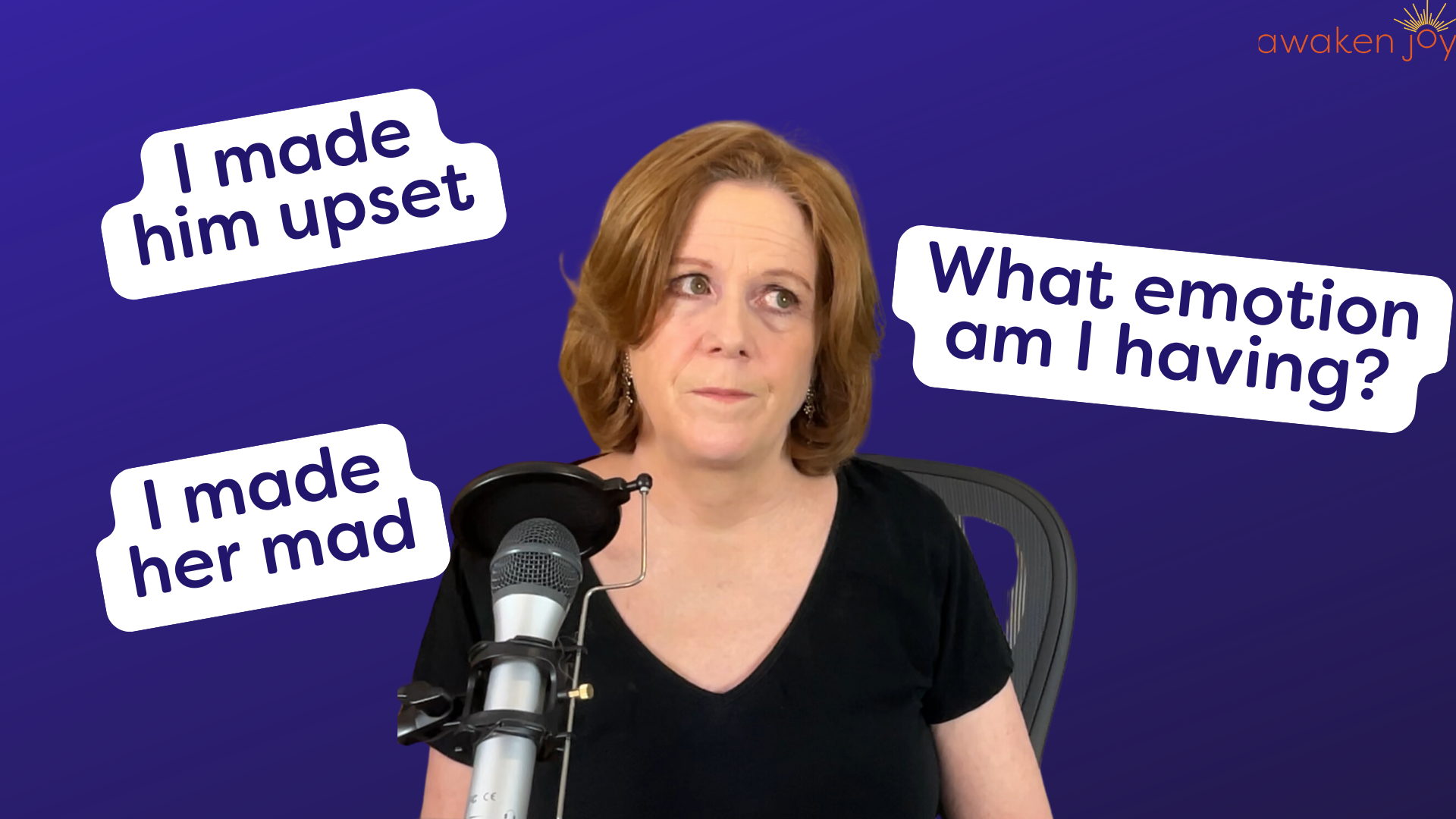
You use language that indicates you cause other people's emotions:  "I made her angry," "I made her depressed," "I made her upset."

You likely also use language that indicates that other people cause your emotions: "He made me mad."

While this language is common, I caution against it and recommend beginning to say: "He did such and such, and my response was to get angry" instead of "He made me mad." Or "I didn't do what she wanted me to do and she got angry because of that"—not "I made her angry."

For people with emotional enmeshment, the concept that we don't actually cause other people's emotions might be hard to understand. It's not only about the language—it's about how you think about it.

Here's a simple example: Some people get very upset if you're late a couple of times to meetings or dinners with them. Other people are perfectly fine with it—they might think, "I love this little bit of relaxation time to play on my phone while waiting." The same behavior from you causes different reactions in different people. They're responsible for their reactions, not you.

Let me know if that made sense to you in the comments below.

Problems Caused By Emotional Enmeshment

You're probably keenly aware of these problems, but let me summarize the key consequences:

**Emotional Dysregulation**

Not being able to identify your own feelings and invalidating your own emotions contributes to emotional dysregulation. Your emotions can swing dramatically from one extreme to another, feel out of control, or you might go into a completely numb state.

**Loss of Self-Identity**

You might not really know yourself. What do you want out of life? What are your preferences? What are your feelings? 

Not knowing yourself means you can't move toward individuation, self-actualization, or achieving what you want—because you don't even know what that is.

**Chronic Anxiety**

You experience chronic anxiety because you're always trying to control something outside your control—other people's responses and emotions. Fundamentally, anxiety is about trying to control something you can't control.

**Persistent Guilt**

You feel guilty about your natural drive to self-actualize or individuate. Whether it's studying something you want to study, doing the kind of work you want to do, or moving where you'd like to move, you feel enormous conflict between moving forward in your own life and fulfilling the role you were given in your family.

How to Heal from Emotional Enmeshment

You really can heal from emotional enmeshment and from having grown up in an enmeshed family system. It will take time and effort, but it's absolutely possible.

I'd like to share the basic concept which underlies healing, and then 5 practical tools you can start using today.

The Basic Concept

Begin thinking about boundaries in terms of where you end and someone else begins. This involves fundamental questions: Who am I? How am I separate? How am I connected?

Five Practical Tools You Can Use Today

1. Journal: "Whose Feeling Am I Feeling?"

When you're experiencing an emotional response, identify whether this is really your emotion or whether you are picking this up from someone else. 

What exactly are you feeling? Journal about it, or if you don't like writing, use audio journaling by recording on your phone.

Beginning to speak about emotions is really helpful for understanding yourself, understanding how you react, what triggers you, and what those triggers create. There's also scientific research showing that verbalizing emotions stimulates a different part of your brain that helps with emotional regulation.

Ask yourself: "Whose feeling is this really? Is it mine to take care of or not?" This tool increases your awareness of how often you might be taking on others' emotions or responsibility for other people's emotions while helping you identify and understand your own.

2. Emotional Boundary Visualization

Visualizing the space around you as your emotional bubble. When you're talking to someone else, you picture them in their own emotional bubble—separate from yours. Visualizing this, thinking it through, and beginning to really feel it can be incredibly helpful.

I offer this visualization in my boundary program, which also focuses on healing the negative core beliefs that interfere with healthy boundaries and learning emotional regulation. 

I also provide the full meditation on  two meditation apps: Insight Timer and Aura Health (each of those links will bring you to the app, and the Aura Health link provides a free month).


3. Fully Accept Your Powerlessness Over Others' Emotions

This might require more exploration and reading, and videos on this topic) but begin to understand that while we can influence other people's emotions, we cannot control them. We can influence them for sure, but usually someone's reaction is more about them and their experiences than anything we've done. This video might be of interest: Accepting Powerlessness or this blog: Setting Boundaries with Family.


4. Use Empowered Language

Move away from enmeshed language toward empowered language. Own your responsibility for your emotions and let other people have responsibility for theirs.

5. Practice Detachment with Love

This concept comes from Al-Anon and other 12-step programs, and it's incredibly helpful. 

Begin to detach in terms of responsibility—not necessarily in terms of connection. 

You detach from the responsibility for the other person's behavior and-or emotions, but you can do so with love. This addresses the paradox of staying in a caring connection and maintaining close relationships without taking on others' emotional burdens.

Therapists are trained in this during their education. You learn how to stay in empathetic connection with someone without letting their emotions overwhelm you. A therapist can remain in empathetic connection with someone who's very upset—possibly discussing something that makes the therapist quite sad—but the therapist doesn't start crying because they've learned to maintain appropriate boundaries.

"Detachment" sounds harsh, but it simply means not getting consumed by the other person's emotion, which actually isn't helpful for them either. Begin experimenting with staying in empathetic connection where you can care and listen, while knowing that your own life and experience are separate.

Moving Forward with Hope

Emotional enmeshment is a complex topic, and healing from it is a process that takes time and often professional support. The tools I've shared can help you begin this journey. Remember that developing healthy emotional boundaries is a skill that improves with practice.

You deserve to know yourself, to feel your own emotions, and to live your own life while still maintaining caring connections with others. The goal isn't to become emotionally disconnected—it's to become emotionally differentiated, where you can care deeply while maintaining your own emotional center.

I go into much more detail in The Ultimate Boundary Course, which focuses extensively on healing the negative core beliefs that interfere with healthy boundaries and developing the emotional regulation skills necessary for maintaining them.

Let me know what you think about this information. Have you recognized yourself in these patterns? What questions do you have about emotional enmeshment? I'd love to hear from you in the comments.
Blog Author: Barbara Heffernan, LCSW, MBA. Barbara is a licensed psychotherapist and specialist in anxiety, trauma, and healthy boundaries. She had a private practice in Connecticut for twenty years before starting her popular YouTube channel designed to help people around the world live a more joyful life. Barbara has a BA from Yale University, an MBA from Columbia University and an MSW from SCSU.  More info on Barbara can be found on her bio page.

Share this with someone who can benefit from this blog!

communication styles of dysfunctional families
By Barbara Heffernan February 5, 2026
Four communication patterns are common in dysfunctional families. Move from the dysfunctional communication style to a healthy communication pattern. This is based on the groundbreaking work of Virginia Satir who identified the placater, blamer, distractor, computer and leveler communication styles common to families
By Barbara Heffernan January 27, 2026
Breaking out of a dysfunctional family role you have held for years—perhaps decades—is one of the most challenging psychological transformations you can undertake. It is difficult, yet, it is achievable. It requires a fundamental shift in how you understand this process and what you can realistically expect. I am going to guide you through seven critical steps, and I encourage you to read through till number seven because it is rarely discussed, yet absolutely essential. Step 1: Focus on What You Can Control This requires a fundamental shift away from thinking about changing the family system or how particular family members respond to your changes. Instead, redirect your focus entirely toward your own healing and growth. You have likely heard this before, but I want to explore it more deeply to help you understand why it is so crucial. I understand the feeling: "But they will not let me change." And I know that it is not easy to face family resistance to your change. To begin this work, shift your focus to these questions: What do I need to heal? What behaviors do I need to change? What beliefs and concepts do I need to release? Here are the specific, concrete steps. Step 1: Analyze the role you have occupied You might already have identifyed the role you have had, and looking into it more deeply will help you determine which behaviors you'll need to change. Then establish a personal boundary around changing that behavior. This provides clarity about what you can do differently within the family system. I will return to this with additional guidance. Breaking out of a rigid family role is fundamentally about individuation—becoming fully the person you are meant to be. Step 2: Reclaim the Parts of Yourself That You Suppressed For each typical family role, there are aspects of ourselves that we suppress. We learn not to reveal those sides of ourselves to our family when we are young. Over time, we move beyond mere suppression to complete rejection of those parts. For example, the caretaker child severs their awareness that they have needs. Their neediness becomes suppressed. The internalized message is: My job is to take care of others, not to receive care. But we all possess the need to be cared for. If you have rejected that part, healing requires reclaiming it. The hero child who must achieve constantly to maintain family equilibrium has likely suppressed the part of themselves that resists such pressure, that simply wants to relax occasionally, that wants to play without purpose or goal. The scapegoat has probably suppressed their own desire to achieve. Why invest effort in achievement when blame is constant and a sibling already occupies the hero role? It feels futile. Yet we all possess parts that crave recognition, and being productive helps us feel good about ourselves. The lost child has likely suppressed the part that wants to be heard, seen, and recognized. We all possess all of these dimensions. Healing means permitting yourself a full range of feelings and multiple behavioral options appropriate to different situations. The healing work of embracing all aspects of yourself is fundamentally important. Step 3: Heal your Negative Core Beliefs Each role generates negative core beliefs. Let me address a common question: Obviously, not every family contains six members to fill each role. People frequently assume multiple roles. Sometimes, following a major family system change, your role might shift over time. But generally, the role you occupied earliest establishes the negative core belief that persists throughout life. Those negative core beliefs might include: My needs do not matter. I cannot trust others. I cannot rely on others. I am invisible. I am unlovable. I am bad. I have a free PDF (if you have not yet downloaded it, you can find it here: Transform Your Negative Core Beliefs ). It helps you identify your deepest core belief and provides three methods for transforming it. Step 4: Establish Internal Emotional Boundaries Boundaries are not solely about refusing requests, dictating how others should behave, or communicating what you will not tolerate. The far more important boundary work is internal. When we develop within an enmeshed family system—and rigid roles guarantee enmeshment exists—we lose the ability to distinguish our emotions from others' emotions. We absorb others' emotions too intensely and then assume responsibility for them. Either we believe we caused those emotions or we feel obligated to manage them. The emotional boundary work is essential. I dedicate substantial time to this in my boundary program , and I will provide more information later in this article. This requires considerable work, and I will direct you to YouTube videos that can assist as well. Step 5: Build a Support System Outside Your Family External support is critical for multiple reasons. When you are raised within a particular system, it is hard to be confident in your new beliefs and opinions. External validation is crucial: "Yes, that is dysfunctional." "No, you should not be required to do that." "No, that treatment is not acceptable." I want to be clear about blame. Blame perpetuates the dysfunctional system. But awareness and fact-finding are very important. I consistently encourage fact-finding regarding your family system, not fault-finding. Fault-finding is easier. Fact-finding asks: How did this affect me? What did I internalize? Where do I struggle to see beyond the framework I was raised in? What rules do I still follow despite rejecting them intellectually, rules that continue driving my behavior? For all these reasons, external support is essential. This might include a therapist, counselor, coach, or supportive friends. Building this support or identifying people who can support you in this process may require effort, but it is worth investing that time. Step 6: Practice Assertive Communication and Discover Your Voice Learning to communicate in a calm, clear manner that respects both yourself and others is essential. Aggressive communication disrespects the other person. Passive communication disrespects yourself. Assertive communication operates from the principle: I'm ok, you're ok. Begin practicing assertive communication outside your family system. Practice with friends or other people in your life first. When you begin practicing with your family, start small—address minor issues initially. The boundary program I offer includes an entire section on assertive communication. Numerous other resources exist, but what matters is beginning practice with the understanding that practice is necessary. It functions like exercise. You must repeat it consistently until it becomes comfortable and natural. Step 7: Leverage the Strengths of Your Role Without the Rigidity Every typical role within a dysfunctional family possesses significant strengths. The goal is transforming these behaviors from automatic compulsions into conscious choices—not reflexive obligations or "shoulds," but genuine choices. This role has protected you for years, perhaps decades. It has shaped substantial aspects of your personality, and you do not need to abandon all of it. Moving toward authentic individuation means developing the capacity to choose behaviors appropriate to specific situations at particular times, and choosing different behaviors at other times. For example, the hero child and caretaker child have developed considerable self-reliance and strength. They likely excel at problem-solving and may be exceptional in crisis situations. But learning to trust others, learning to accept your vulnerability so you can cultivate genuine intimate relationships—not necessarily within your family of origin, but in your adult life—means releasing the requirement to always be the strong one. The scapegoat has likely become a truth-teller. This is a valuable capacity for advocacy, both self-advocacy and advocacy for others. Many changemakers in our world - advocates for underserved populations - were scapegoats in childhood. The mascot has developed a wonderful sense of humor and likely possesses strong skills in helping others feel at ease. That aspect of your personality need not be relinquished. It brings pleasure to many. But developing deeper relationships probably requires stepping out of that role periodically so you can address conflict directly, listen to others' difficulties without deflecting through humor, and acknowledge your own loneliness and perhaps your feeling that nobody truly knows you. Accepting your own vulnerability is essential. The lost child has probably developed substantial self-reliance as an adult and likely possesses considerable creativity. But learning to trust others, learning to accept appropriate dependence enables you to find people you can rely on and people with whom you can be authentic, so you can express your voice and bring your creativity and special talents more actively into the world. Additional Resources Family systems resist change profoundly. I released a comprehensive video and blog on this topic last week, which I will link ( Blog: Dysfunctional Family Roles: Why Is It So Hard To Change? and Video here ). Understanding why family system change is so difficult reduces the self-blame we experience when we feel stuck. It can also shift blame away from the family system because these patterns are transmitted intergenerationally. Depending on your current position in this journey, here are additional resources: If you are uncertain what the dysfunctional family roles are, I have a video explaining them . If you want to understand enmeshment more deeply, I have videos addressing that concept. Therapy helps, coaching helps, but I recognize they are time-intensive and expensive. That reality led me to create an 8-week boundary course accessible from anywhere. The cost is probably less than two therapy sessions. Let me share feedback from three people who completed the program - these testimonials are taken directly from the google doc I created to gather feedback: "Your great program is really a lifechanger. It is not just a slogan." "Everything was very helpful. I am a much different person in a good way than I was eight weeks ago." "I have been helped to look underneath all of the unhealthy messages and negative core beliefs that I picked up in childhood and throughout my life. Really, just lots of wonderful, empowering information. Thank you so much for your compassionate and important work."" If this material resonates with you, I encourage you to explore that course. Information is here: The Ultimate Boundary Course . Let me know your thoughts on these seven steps and whether this article has been helpful. I will see you next week.
By Barbara Heffernan January 16, 2026
Do you keep finding yourself back in the same patterns, performing the same behaviors, playing the same part? Do you feel angry at your family for refusing to accept your changed behavior? Or do you direct that frustration inward, berating yourself for repeatedly falling into those familiar grooves? This frustration is not a personal failing. There are well-researched, deeply rooted reasons why escaping dysfunctional family roles is extraordinarily difficult. Understanding these reasons—both the external forces that pressure you to stay in your role and the internal patterns that keep you locked in place—is essential for meaningful change. When you understand why the path is so difficult, you can navigate it more effectively. There are reasons external to you that make change difficult, and there are internal reasons it is challenging. Let's start with the external reasons. External Reasons Why Change Is Difficult 1. Families Are Systems, and Systems Resist Change The most significant external obstacle is that families are systems, and systems are profoundly resistant to change. If you consider how challenging it is for you as an individual to change in any context, then imagine that difficulty multiplied exponentially when you place multiple people together in a system. The difficulty quotient explodes. When one person changes within a system, it requires everyone else in that system to adjust. Systems inherently attempt to maintain equilibrium and sustain themselves. When we think about the family roles that developed, we can envision being in a play. Everyone has their assigned role. Everyone wears the same costume. Everyone knows their lines. If you recently came home from holidays with your family, this will resonate because you know which person will get angry, which person will disappear, which person will criticize you, which person expects you to do everything perfectly. You know all the roles. If you were in a play wearing your costume, and everyone had rehearsed their lines, what would happen if someone walked on stage and started doing something completely different? You would probably feel confused, possibly angry. How can they just change their role? What does it mean for my role? What if someone starts playing my role? What does that mean for me? This analogy illuminates why system change is so challenging. Compounding this difficulty is the fact that these roles have been transmitted from one generation to the next to the next. Dysfunctional families emerge around major stressors, whether those stresses originate externally or internally. The dysfunction develops as a response to extreme stress, and this pattern has repeated for generations. Change is possible—though the change may not manifest exactly as you envision it. 2. Family Enmeshment and Pressure to Stay in Your Role The next obstacle involves family enmeshment and the pressures exerted on you to remain in your role. In dysfunctional families, roles become rigid and people become intensely attached to their own role and to the roles of others. The family system employs specific tools to keep you in your designated place. Often that tool is shame—shaming you for changing your behavior or shaming you for not helping or fulfilling your expected duties. The pressure might manifest as pleading, begging, or pulling on your heartstrings. The family system has numerous strategies to pull you back into your assigned position, and these pressures are extraordinarily difficult to withstand. 3. Environmental Triggers Another external pressure involves environmental triggers for the behavior. You might have engaged in substantial recovery work and modified many of your behaviors. But the moment you enter that environment—perhaps simply arriving in your hometown, perhaps turning the door knob and walking into your childhood home—those environmental triggers signal to your primitive brain to return to old behavior. You may not even consciously register these signals. We will explore this further in the internal pressures section because it relates fundamentally to how your neurobiology operates. These external triggers release an almost subconscious internal message: "You must behave that way. Do not resist. Just do it." It is not conscious. It is not verbal. It simply happens—you move directly into the pattern. 4. The "Social Echo Chamber" (unrelated to social media!) Once we have developed this role as a child and it has become deeply ingrained, we frequently replicate that role as adults with close friends, other family members, spouses, and our own children. We have been trained to perform this role and we seek relationships within which we can continue performing it. It functions like an echo chamber because the social pressures of all these systems reinforce your role maintenance. I recognize this may sound discouraging, but there is genuine hope here. Bear with me till the end! Internal Reasons Why Change Is Difficult 1. Attachment Wiring All humans are born with an inherent need for attachment. Children depend on their caregivers for survival and safety. This attachment wiring is neurobiologically hardwired into us. We learn very young to conform in order to maintain attachment. By conform, I do not mean conforming to your parents or caregivers, but conforming to what they required of us. 2. Neurobiological Habit Formation This attachment wiring establishes certain patterns and behaviors that become progressively reinforced because our neurobiology becomes structured through repeated patterns and behaviors. Certain situations and our responses—both our reactions and emotions as well as our behaviors—become neurally connected. They become myelinated, allowing different parts of the brain to communicate with extraordinary speed. We can describe this as neurobiological habit formation, and it renders much of our behavior automatic. This explains why we choose relationships that recreate these patterns when we are adults, even when our conscious mind understands better. They are familiar. They are what our automatic brain, our emotional brain, the older regions of our brain recognize and know how to navigate. Our brains are energy-conserving organs. When a habit exists, the brain defaults to that pathway because it requires less energy. Changing these patterns demands substantial conscious effort, but change is achievable. 3. Parts Rejection The third internal obstacle is what I call parts rejection. When we adopt a particular family role, we must simultaneously suppress certain aspects of ourselves. For example, if you were the caretaker child, fulfilling that role required suppressing your own needs. You had to eliminate your own neediness. Everyone possesses needs, but yours became hidden away. You may also have had to suppress your desire to play and be carefree because you were required to focus on caretaking. If you were the youngest of four children and became the lost child, tasked with disappearing and creating no trouble, you had to suppress the part of yourself that wanted to be seen, the part that craved acknowledgment. The scapegoat might have had to suppress the part of themselves that wanted to achieve. Perhaps because the hero child already occupied that role, or perhaps because achievement felt futile. If everyone blames you for everything, why invest effort in achievement and excellence? It feels hopeless. So you not only stop trying, but you suppress the part of yourself that would aspire to such things. Similarly, the mascot—the child who makes everyone laugh—might deflect any controversy, attempting to make everyone feel better by changing the subject. You learn to avoid serious topics. You learn that humor is your designated response to conflict. The part of you that would like to advocate for change becomes suppressed as well. When we suppress these parts of ourselves, we do not simply set them aside temporarily. We attempt to sever them entirely. We pretend they do not exist. Part of healing work, which I will address next week, involves reclaiming those lost aspects of yourself. We all possess multifaceted selves, which is one of the most damaging aspects of rigid family roles. They reduce us to a single dimension, and we participate in this reduction. Not through fault, but through learned behavior. We learn to suppress these parts because it feels easier. 4. Deep Negative Core Beliefs Related to this suppression, we develop profound negative core beliefs. We develop deep negative beliefs primarily about ourselves and secondarily about the world. These negative core beliefs persist throughout our lives until we consciously work to heal and transform them (which is possible!). The caretaker child likely develops beliefs such as "my needs do not matter" or "I am not important." But they might also develop beliefs like "I cannot trust others" or "I cannot depend on others" or "I am the only one who can handle this." These beliefs become so deeply embedded that we continue enacting them throughout our lives. To assist you with this, I have a free PDF called Transform Your Negative Core Beliefs . It helps you identify your deepest core beliefs—the one or two that are most fundamental for you. It also provides three methods to begin transforming them. (You can access it by clicking that link). 5. Inability to Think Outside the Box The fifth internalized obstacle is that we struggle to think outside the box when we have been conditioned within it. This inability to see beyond the established framework—I witnessed this repeatedly with clients throughout my 20 years practicing psychotherapy. Even after substantial recovery work, people would revert to statements like "Well, I am truly bad" (that negative core belief IS absolutely true), or "I genuinely cannot say no in this situation with my family," or "I cannot reveal what actually happened in my home." These kinds of beliefs can profoundly limit you. Eventually it is possible to change these beliefs, but outside perspectives are invaluable—self-help videos, books, therapy, coaching, or a genuinely caring friend. And then, as we begin to change, we are plagued with self-doubt. We question ourselves constantly. Do I actually have the right to prioritize my own needs? Do I have the right to decline helping that family member for the 99th time this month? Perhaps refusing makes me a bad person. The outside perspective helps with this as well as: challenging internalized negative core beliefs, questioning entrenched family rules, questioning the imperative to keep family secrets, and developing clarity about your own values and morals. 6. Your Own Reactivity The sixth obstacle is our own reactivity. When the pressure from family enmeshment intensifies, when the family system begins shaming you or pleading with you or arguing with you, your own reactivity becomes a major impediment to maintaining your path. Your reactivity might manifest as anxiety—intense, consuming anxiety. It might manifest as anger—you lash out intensely and later experience guilt. You might retreat entirely. Whatever your typical pattern—fight, flight, or freeze—you will likely default to one of these responses, or perhaps one you are actively working to modify. Regardless, the reactivity interferes with your ability to hold your ground. Another manifestation of reactivity is self-doubt, which relates to the inability to think outside the box. You begin doubting yourself, doubting your behavior, your actions, your values. Learning emotional regulation and dedicating yourself to that practice is tremendously helpful. I will expand on this next week. 7. Fear of Abandonment The final obstacle is fear of abandonment. Though this might be better described as a deep desire for a functioning family system and acceptance. Let me explain. Our initial attachment wiring makes us deeply averse to losing the bond with our family. If the family threatens to sever ties with you because of your behavior change, that threat is genuinely terrifying, and our fear response is profound. Yet intertwined with this fear of abandonment is the fervent desire that they change. And even more, you probably believe they should change. And I would likely agree with you that they should change. But that does not mean they will. Are they working on it? Are they attempting to change? Do they want to change? If they do not want to change, if they are not working on it, if they are not genuinely trying, they will probably not change. Even those of us who are actively working on change, who want to change and invest substantial effort in changing, still find transformation difficult. Further, we desperately desire acceptance from our family, making it nearly unbearable to accept that we can change while they remain unwilling to embrace that change. I label this fear of abandonment, but perhaps it should more accurately be termed desire for attachment. It represents that profound instinctual and biological drive to maintain connection with our family of origin, which is entirely understandable. But eventually we may need to acknowledge that it will not unfold as we hope, and that realization may initiate a grieving process. We might also be using all-or-nothing thinking—either they accept the new me or I must cut them off entirely. This will increase the fervent desire that they change. Final Thoughts These are the reasons transformation is so challenging. I would genuinely value your perspective. If you comment below, I will read it and may use it to inform future content. I would especially appreciate knowing whether understanding why these changes are so difficult helps you understand yourself or your family better, and whether it provides insights into what you might need to address next. Next week, I will provide an extensive overview of how to actually transform these roles, incorporating all these factors. I sincerely hope this was helpful, and I will see you next week. A few blogs you might find useful in the meantime: Dysfunctional Family Roles , or this playlist in YouTube: Dysfunctional Family Roles
By Barbara Heffernan January 6, 2026
How much of your anxiety is about avoiding disappointment? Whether you have a fear of being disappointed, a fear of disappointing others, or a fear of disappointing ourselves, this desire to avoid disappointment can drive a lot of anxiety.
By Barbara Heffernan December 22, 2025
Is your concern reasonable or do you have problematic anxiety? This blog clearly outlines how to tell the difference and how to determine if your approach to your problem is reasonable or anxiety.
By Barbara Heffernan December 19, 2025
For some people, disappointment becomes a catalyst for growth. For many others, it triggers a descent into increasingly negative thinking patterns. The negative thinking reflects deep-seated negative core beliefs and is riddled with cognitive distortions—systematic errors in reasoning that distort reality and intensify emotional pain. Today I want to explain how cognitive distortions fuel the downward cycle. I will help you recognize these distortions in real time and provide practical tools so you can interrupt this cycle. Ideally, you will be able to extract useful information from disappointment. But even if you cannot get there yet, at least we can stop the downward spiral. How Disappointment Triggers Cognitive Distortions Something does not work out—something you hoped for, wanted, or needed does not happen the way you wanted. That leads to disappointment. Then your brain constructs a story about why the disappointment happened and how you should feel about it. Very often that story centers on what is wrong with you . We can move rapidly from disappointment to believing that the event not working out proves our negative beliefs about ourselves: "I am defective, I am not good enough, I am unlovable." The Cognitive Distortions That Fuel the Spiral Cognitive distortions are rigid, patterned ways of thinking. They can affect us across many areas of life. It is valuable to know which are your "go-to" cognitive distortions so that you can begin to recognize them when they occur. You become more aware of the thinking pattern and can observe, "There I go again. I am labeling. I am personalizing." That recognition creates distance between the thought pattern and our reaction to it. We are creating psychological space for ourselves and developing the observer mind—that wise part of the brain that notices these patterns and can evaluate them: Is this helpful? Is this not helpful? Personalization Personalization is when we take an event and make it about us—about our worth, our character, or what we did wrong—even when there are many other factors at play. A friend canceled plans, and we jump to the thought "they do not like me", or "I did something wrong the last time I saw them. We don't get a job we wanted, and we jump to "I am incompetent" or "nothing good ever happens to me because I do not deserve it, because I am not worthy." The event becomes personalized. I can hear you thinking that these things are personal. Yes and no. They personally happen to you, but if a friend cancels plans, there are countless possible reasons. The same applies when we do not get a job—there is much that is random and beyond our control. Labeling Labeling is when we reduce ourselves (or others) to a single defining characteristic, taking complex people and complex situations and drilling them down to one statement that supposedly covers everything. I" am defective." "I am incompetent." Labeling is a cognitive distortion because reality is never that simple. By nature, such statements are exaggerated and inaccurate. Overgeneralization Overgeneralization is when we take a single negative event and extrapolate it into a permanent, universal pattern. "I did not get this job, therefore I will never get a job." "I had a couple of dates with that person and really liked them, but they decided not to see me anymore, therefore I will never find a partner." A single negative event is extrapolated into a permanent pattern: this is how it will always be. Emotional Reasoning Emotional reasoning is when we assume that because we feel something intensely, it must be true. We draw conclusions based solely on our current emotional state rather than on evidence. "I feel like a failure, therefore I am a failure." "I feel right now like nothing will ever work out for me, therefore nothing will work out for me. I will defend this belief both to myself and to others because if I feel it this intensely, it must be true." But our feelings reflect our current emotional state. They are not predictors of the future. Emotional reasoning occurs when we draw conclusions based solely on how we feel in the moment, and usually those conclusions contain other cognitive distortions, such as catastrophizing.. Catastrophizing Catastrophizing is a cognitive distortion that conjures a worst-case scenario and then treats it as 100% certain to occur. As we catastrophize, our primitive brain, which controls much of our neurochemistry—our stress chemicals, our feel-good chemicals—does not distinguish between our catastrophic imaginings and reality. It does not recognize these stories as fiction. We often generate the stress chemicals that correspond to the catastrophic story. Those stress chemicals then amplify the rest of the cycle. Sometimes these are also shutdown chemicals that leave us feeling numbed or wanting to collapse. Catastrophizing almost invariably accompanies this type of reaction to disappointment. All-or-Nothing Thinking All-or-nothing thinking is when we see things in extreme, black-and-white terms with no middle ground. If something is not perfect, it is a complete failure. All-or-nothing thinking can create avoidance, which impacts our behavior. "I am not going to get a job like that, so why bother?" "I should not try to improve my situation at all. I will probably just be disappointed again, so I will not even try." This pattern is extremely common. Avoidance can lead to chronic disappointment and genuine hopelessness. Last week's video addressed chronic disappointment and its impact (you can find the blog here and the video here ). This avoidance constricts our world. We do not pursue what we want. We may even sever our connection to wanting because all wanting has ever done is cause pain. The Role of Negative Core Beliefs If you listen carefully to all these examples, you can hear that the themes are tied to negative core beliefs: I am defective, I am not good enough. Sometimes they are negative beliefs about the world: Nothing will ever work out for me. True healing requires addressing these very core negative beliefs. I have several videos on this topic, and I also have a free PDF that helps you identify your specific negative belief and provides three tools to begin transforming it. Five Tools to Break the Cycle Tool 1: Build Awareness We cannot change what we are not aware of. This week when you experience disappointment, which you likely will, notice where your thinking goes and see if it corresponds to any of the cognitive distortions I mentioned. If you are able to identify a cognitive distortion, label it: this is catastrophizing, this is all-or-nothing thinking, this is personalization. Even if you cannot stop the distortion, simply labeling it creates the distance between you and your thoughts. You can combine this with labeling the feeling you are experiencing. Scientific studies demonstrate that labeling your thoughts and feelings aids emotional regulation. The simple act of labeling activates a different part of your brain—the prefrontal cortex—which helps calm the amygdala and the fight-flight-freeze response. Tool 2: Challenge These Thoughts With Reality Check Questions Ask yourself: Whatever I am imagining about the future, the disaster scenario I have constructed—is this happening right now? Is this guaranteed to happen? Is it 100% certain? Do I need the stress chemicals I am generating right now as I think about this? If it is not happening right now, I do not need these stress chemicals. Is there something I can do about this right now? Part of the reality check involves determining whether you can physiologically calm your body while thinking through whatever problem exists. There are always problems, and your disappointment likely stems from a real problem. Some of these problems are extremely important, but they do not require this kind of distorted thinking or these chemicals. What they require is full-brain problem-solving. Sometimes it is helpful to write down what we are feeling or thinking. If we feel too overwhelmed, we can decide, "I can't think this through right now, but I will schedule time tomorrow or the next day to think this through." As we write down what we are feeling and thinking, we can begin to identify any statements that reflect cognitive distortions. Once something is identified as a cognitive distortion, we can acknwoledge that it is not accurate. A distortion by definition means this. Even if it FEELS true, we can KNOW it is not. Simply creating distance by acknowledging that these automatically arising thoughts, which feel so true, are actually distorted, can be powerful. Obviously a therapist can be invaluable in this work. An outside perspective can bring richness that we cannot access when we are cycling through the same thoughts repeatedly. I encourage you, if you have access to quality therapy and you struggle with this, to reach out. Tool 3: Identify the Negative Core Belief See if you can identify common themes in how you think about recent disappointments. Identify the negative core belief driving those cognitive distortions, the negative core belief driving your response to disappointment. Healing these negative core beliefs cannot be accomplished with a brief article. It may require long-term therapy. It is profoundly worthwhile to undertake the investigation and healing work. In working with people over 20 years as a psychotherapist, I found that addressing this was one way to reach the root issues driving most problems. There is a common thread, and it traces back to a traumatic event in childhood or a difficult situation that fostered negative beliefs about ourselves. I have a free PDF that lists very common negative core beliefs. It guides you through a process to identify your key negative core belief and provides three tools to begin transforming it. Click here for the PDF. Tool 4: Develop a Reasonably Stated Positive Core Belief that Counters the Negative Reasonably stated means you do not need to leap from "I am completely unworthy" to "I am the most worthy person in the world." We do not need to go from "I am stupid" to "I am brilliant." It is simply "I am smart enough, I am worthy enough, I am as worthy as any other human being." There are many reasons we phrase this with moderate language, but primarily because our brain will argue against absolute positives. Curiously, our brains do not argue against absolute negatives. "I am stupid, I am worthless"—somehow our brain accepts that. But if we propose the exact opposite, our brain will reject it immediately. So: I am smart enough, I am good enough, I am lovable enough. Develop the positive core belief. The PDF I mentioned also assists with this step . Once you develop it, write a list of evidence that the reasonably stated positive core belief is true. Tool 5: Identify Action Steps If you believed that reasonably stated positive core belief, what action would you take? I know you probably do not believe the positive statement at this point, but imagine: if you believed it, what would you do? If this is too hard to imagine, think about someone else who believed they were good enough—what would they do? Then push yourself to do this action. What is the worst outcome? You feel disappointed. If we could sit with our disappointment, allow ourselves to feel it, acknowledge that we dislike it and it feels terrible, but recognize that all emotional states are temporary—if we allow them to process through, they will pass. If we suppress them or push them away, they can become rigidly stuck. Generally, if we allow ourselves to feel disappointment, the feeling will ebb and flow. If we develop even a slight sense of "I can handle being disappointed," that alone will interrupt the negative cycle. I hope this was helpful and I will see you next week!
By Barbara Heffernan December 11, 2025
Are you suffering from a lack of motivation? Chronic disappointment might be the cause. This blog illuminates the impact that chronic disappointment has on our motivation and highlights what you can do to rewire your brain to be more motivated.
By Barbara Heffernan December 4, 2025
Disappointment can cause emotional chaos and emotional dysregulation. This important emotion is often overlooked. Learning to deal with disappointment can help you regulate your emotions.
By Barbara Heffernan November 26, 2025
You've left your family of origin, done personal growth work, and become a much more well-rounded person . You mostly feel good about yourself., or maybe you even feel really good about yourself! Yet when you go home for the holidays, it seems you turn right back into your old role! It's like a time machine because you suddenly begin to react the way you would have when you were much younger. You remind yourself of your 7, 10 or 14 year-old self and you think, " How could I be acting this way ?" Today's blog will give you a quick rundown of how these family roles typically present during family events and holidays. The Hero Child or Caretaker The hero child or caretaker is usually the one cooking all the food, cleaning up, arranging the events, even coordinating how other family members get there. If this is you, you probably make sure you're buying gifts for everybody. You might even buy gifts for that relative who never buys gifts for others so that person has something to give. You might be doing everything for everybody because that's always been your role within your family system. What does it lead to? Exhaustion, irritability, resentment, stress, and even loneliness. Because even with all the effort you've put in, you're not getting the feeling you're looking for. You're not getting a return on that effort. And the resentment you feel is toxic for you. Resentment is like taking poison but hoping it hurts the other person. It's a toxic emotion to feel, and it often signals that we're doing too much. Suggestions if this is your role: Pull back a little. Let things not be perfect. Let things slide. The Scapegoat The scapegoat grew up being blamed for everything, and it probably still seems to happen when your family of origin gets together. You probably dread going to the holidays because you know you're going to be criticized about everything. Anything that goes wrong will be blamed on you. You'll probably be resented by the hero child I just described. Even if you've stepped out of this role in other areas of your life, you still might act out or do something that justifies some of their blame or criticism. That's a miserable place to be. It can also be a really lonely place. You feel hurt. Nobody seems to understand or acknowledge that. It's exhausting. The Lost Child The Lost Child often skips out on holiday events. If this is you, you might live across the world from your family. You probably hate the conflict that arises during the holidays. You don't want to be part of it and you can't tolerate the arguing. You avoid asserting your own needs because that usually creates conflict, and you feel it isn't worth it. But then you end up feeling unseen, unheard and uncared for. The Mascot And then if you're the mascot, you're expected to tell jokes and keep everybody cheerful. It doesn't matter how you're really feeling inside—you need to make those jokes. You need to cheer everybody up. You need to provide entertainment and distraction from any real problems. You probably end up feeling alone, because nobody really knows you. You might even be resentful at the other family members - the lost child who just disappears and doesn't deal with anything, the Hero Child is stressing themselves out for no reason, and the Scapegoat who keeps causing chaos. Suggestions: Prior to your family gathering, you can identify one or two behaviors that you would like to change and set a boundary for yourself. This boundary is not dependent on anyone else - it is dependent on you changing how you respond to everyone else who is probably doing what they always do! Be compassionate with yourself. Breaking these patterns is SO hard! Be gentle and understanding if you slip back. Try to have compassion for your family... know that they developed their role as a way to cope with the same problem. And for your parents - they grew up in their own families of origin and may have suffered in ways no one is aware of. This does not mean you have to accept unacceptable behavior!! Just know that judging often leads to more isolation and to resentment. I wish you peace and joy this holiday season!
By Barbara Heffernan November 20, 2025
Have you ever had a reaction to something that seemed way out of proportion to what actually happened? These overwhelming responses aren't character flaws or overreactions—they're emotional triggers, and understanding them can transform how you view yourself and others