
Anxiety: When Your Body Responds to Made-Up Stories
Barbara Heffernan • June 4, 2025

Our bodies physically respond to anxious thoughts...just as if we're watching a stressful movie.
In this blog, I'll discuss why and how this happens. I'll also go into some super interesting scientific research on movies that is demonstrating how strongly our brains and bodies respond to "made-up" stories.
And most importantly, I'll provide guidance about how to use this information to calm your own anxiety. Whether your anxiety starts with worrying thoughts or a physical feeling, this will help! approach to understanding anxiety will be tremendously helpful for your recovery.
The Cognitive Behavioral Therapy Cycle
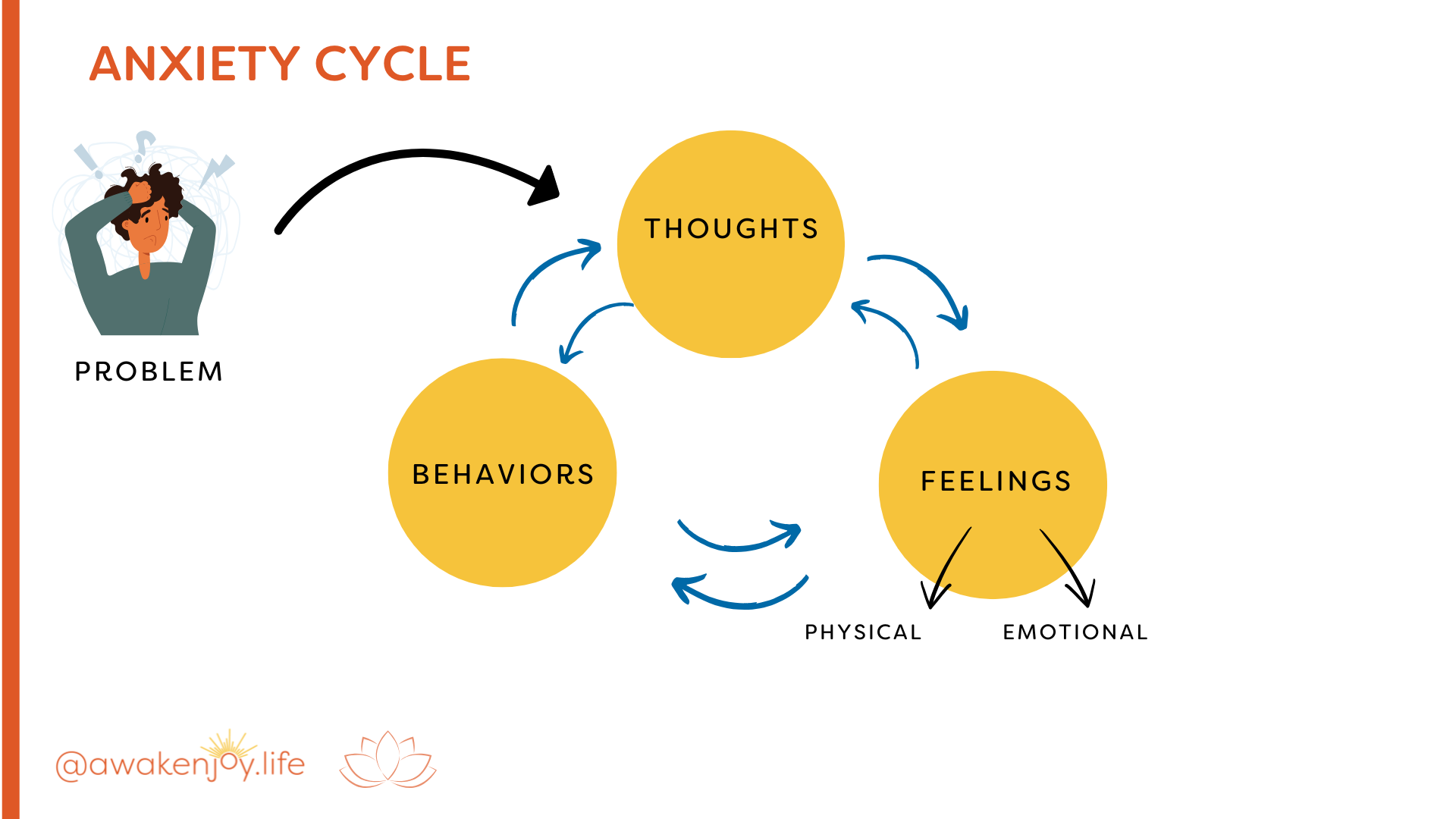
If you've watched my videos or read other blogs, you're hopefully familiar with the cognitive behavioral therapy cycle. The basic principle is that your thoughts impact your feelings and behaviors, your feelings impact your thoughts and behaviors, and your behaviors impact your thoughts and feelings. All these elements cycle together in an interconnected loop.
While we generally think about anxiety as starting with a problem—an external problem confronts us and we respond with thoughts that feed the anxious cycle—this isn't always the case. For some people, sensory information actually triggers the initial response. It could be a smell, sight, or sound that directly triggers anxiety without any conscious thought process.
Understanding where your personal cycle typically begins matters for healing, which I'll address at the end of this article. However, regardless of where your cycle starts, it will cycle through all components: thoughts, feelings, and behaviors reinforcing each other.
Two Pathways: External Problems and Sensory Triggers
**When External Problems Trigger Anxiety**
Let me start with anxiety that begins with external problems. The problems that most commonly impact our anxiety share certain characteristics: they involve significant uncertainty, focus on outcomes we desperately want but can't completely control, and require us to project into an uncertain future.
We might focus intensely on getting the job, achieving happiness, or attaining whatever we define as success. Because there are elements outside our control and enormous uncertainty involved, we begin projecting into the future, imagining potential obstacles and complications. This forms the basis of cognitive anxiety—anxiety that originates with our thoughts.
This process leads to catastrophic thinking—imagining we'll encounter one problem after another and wanting to prevent all these potential problems. Since none of these imagined problems are occurring right now, we can't actually prevent any of them in the present moment, yet we feel compelled to anticipate every possibility. This mental process fuels increasing anxiety.
As we fuel anxiety through catastrophic thinking, we generate intense physical symptoms. These are fight, flight, and freeze responses driven by the amygdala and other primitive brain regions. These physical symptoms then convince the rest of our system that we truly do need to be anxious, creating a self-reinforcing cycle where physical symptoms validate our anxious thinking, which increases both anxious thoughts and anxious behaviors. The entire cycle—thoughts, feelings, and behaviors—spirals out of control.
**When Sensory Information Triggers Anxiety**
The other pathway occurs when anxiety starts with physical sensations triggered by sensory information, often without conscious awareness. Many people experience sudden panic attacks and report, "I wasn't anxious, I wasn't thinking about anything worrying, and suddenly I started having this panic."
However, once those physical symptoms appear, they typically trigger the cognitive component of the cycle. The moment you notice these physical sensations, cognitive worry often begins: "Oh no, why am I having this symptom? Something must be wrong with me. Maybe this really isn't anxiety. Maybe there's something else wrong with me."
If we could experience those physical symptoms and simply acknowledge, "Oh, that's happening again," without creating a worry narrative around them, we wouldn't be feeding the anxious cycle. I'll discuss at the end of this article why anxiety triggered by sensory information happens, often completely beneath conscious awareness.
I want to mention that whether your anxiety starts with external problems leading to catastrophic thinking, or it starts with physical feelings triggered by sensory information, the cycle operates similarly. Many people experience sudden panic attacks and say, "I wasn't anxious, I wasn't thinking about anything worrying, and suddenly I started having this panic."
However, once you have those physical symptoms and pay attention to this pattern, you'll begin to see the cycle. Once you experience those physical symptoms, you enter cognitive worry: "Oh no, why am I having this symptom? Something must be wrong with me. Maybe this really isn't anxiety. Maybe there's something else wrong with me."
If we could experience some of those physical symptoms and simply think, "Oh, that's happening again," without worrying about it, we wouldn't be feeding this cycle.
I hope this makes sense. I'll discuss at the end why anxiety triggered by sensory information happens, often without your conscious awareness.
The Evolutionary Basis of Our Physical Response
Humans evolved, and our brains evolved, with a primary focus on survival. Our brain developed to keep us safe and alive. The amygdala, which plays a key role in this process, primes us to fight, flee, or freeze whenever there's a threat.
Here's the crucial point: **the amygdala cannot differentiate between real and imagined threats**. This is where we need our frontal lobe to intervene, calm the amygdala, and recognize, "This isn't actually a dinosaur chasing me." I have several videos about amygdala hijacks and being triggered, which will be useful if you're interested in this topic.
The key point is that made-up stories trigger the same physical response as if the situation were actually happening.
The Movie Research Connection
Let's consider movies. We know they're not real, yet we still respond physiologically. I'm someone who jumps constantly during movies when something scary or shocking happens—I have a very external expression of it. Not everyone does, but many people do, and we all feel something.
Current research on movies and their effects on our brain and body is fascinating. The research demonstrates measurable physical responses to movie events. We know movies aren't passive experiences, but the fact that they trigger measurable changes is remarkable. Researchers can measure hormonal changes and electrodermal activity (the amount of sweat on your skin). These are subtle changes that vary with different emotions.
Electrodermal activity is one tool researchers use to observe physiological changes in humans tied to emotions while watching movies. Heart rate and blood pressure are measured during movies. There are now numerous studies using fMRIs to examine brain imaging and brain activity while people watch movies.
When we watch scary movies, our innate fight, flight, and freeze response activates, preparing us for immediate danger even though the danger isn't real and isn't physically present. Simply being frightened by the story triggers measurable spikes in adrenaline and cortisol levels—our stress chemicals.
This provides a powerful example of how our bodies respond to imaginary threats, responding the same way to those anxious made-up stories in our minds.
Positive Research Findings
There's also positive research about movies. Watching comedies and laughing actually lowers blood pressure—we should all watch more comedies! Heart rates can reach 40 to 80% of their maximum rate (the range doctors recommend for exercise) and can remain elevated for extended periods during movies, which could actually be beneficial.
Another key finding is that heart rates and electrodermal activity—all physiological data—fluctuate with the narrative arc. As the story changes, so does people's physiology. Some research shows that audience members' heartbeats begin to beat in synchrony with each other, which is fascinating.
This makes me think about how when we're next to someone who's anxious, we probably feel more anxious ourselves. We pick up on each other's moods, emotions, and sometimes physiological states.
Brain Imaging Research
fMRI studies show that stressful movies can trigger the same neural circuits involved in anxiety—the same brain circuitry that fires together during anxious feelings. Movie watching actually recreates emotional states accurately—the same emotional states we experience in real life.
There are increasing fMRI studies examining brain function during movies, mapping brain areas that activate with different emotional states. Researchers are using this in studies of affective and emotional disorders, including anxiety.
This research definitely connects to those made-up stories in our minds.
How to Calm Your Anxiety
What do you do about this? How do you calm your anxiety? I have numerous videos on this topic—I'll provide highlights here and point to areas you might want to investigate further.
**1. Increase Awareness of the Thought-Feeling Connection**
To calm your anxiety, first increase your awareness of the connection between your thoughts and feelings. Use this growing awareness to separate the physical feeling from the "made-up story." I use "made-up story" in quotes because I know there are real problems, but they're being projected into the future where what you're worrying about isn't happening right now.
Separate that physical response as much as possible from those thoughts. The intense physical response triggered by catastrophizing isn't congruent with the present moment—sitting here in this environment right now. It's also unnecessary for solving the problem. In fact, it can interfere with actually solving the problem.
**2. Understand Your Personal Anxiety Cycle**
Really understand your anxiety cycle. Does your cycle start with external problems? Does it start with internal feelings? Does it start with sensory experiences? If external, what types of events trigger it? What are you anticipating? How does this impact your thoughts, feelings, and behaviors? How does this cycle work for you?
Behaviors can either contribute to anxiety or help you calm down. Become intimately aware of your personal anxiety cycle.
**3. Prioritize Calming Your Physical System**
Calming your physiological state is one of the most powerful interventions available. It truly communicates to older brain parts—the amygdala and ancient areas that don't have language centers—that you're actually safe.
Essential tools include diaphragmatic breathing and grounding techniques. I recommend practicing these regularly on a daily basis, preferably when you're not highly anxious. Begin doing them regularly every day, and you'll develop the ability to access them during more anxious states. This builds over time like a habit, like a muscle that grows stronger.
**4. Identify Helpful and Harmful Behaviors**
Identify behaviors that contribute to your anxious cycle and those that break it. Consider how your behaviors—whether compulsive or avoidant—contribute to your anxiety. If you're afraid of something and avoid it, you're communicating to your primitive brain, "This is really scary; I better run away."
Identify what those behaviors are and what behaviors you can implement to cut the cycle, calm yourself, and change the pathways. Behavior is actually the most powerful way to change your brain circuitry and create new neural pathways.
Habitual physical reactions get different brain regions working together rapidly. Your brain develops neural pathways where this event leads to this feeling, leads to this thought, and it accelerates with repetition. Habits of anxiety and habits of relaxation are equally important.
**A Practice Exercise**
One thing you can practice—this is just one idea among many—is actually calming your body while thinking about the situation that frightens, triggers, or worries you. Think about that situation while doing diaphragmatic breathing or grounding techniques and observe what happens.
If you haven't seen my free webinar, "Rewire Your Brain for Joy and Confidence," it explores the concept of neural pathways and what you can do to change them to feel less anxious and focus more on joy. It covers what behaviors you need to change, and I think you'll find it helpful.
Conclusion and Future Content
Pay attention to what behaviors you can implement to help break the cycle. These can include diaphragmatic breathing and grounding techniques, as well as taking walks, petting animals, and similar activities.
I know some viewers would like more information about the actual physical symptoms of anxiety, but including everything would make this article too long. My next article will focus on the physical symptoms of anxiety, so make sure to subscribe to my channel.
Another question many viewers have is, "I don't have a story." People who feel their anxiety is triggered by internal feelings or external sensory information often feel there was no story when it started. I'll address this in an upcoming article about "what if there is no story."
In that article, I'll discuss how past experiences link sensory information with emotional responses. These connections become deeply embedded in our brain and can be positive or negative. Positive sensory experiences can evoke emotions (like the smell of your grandmother's cooking), but for people prone to anxiety, many things can trigger anxiety beneath conscious awareness.
How does the connection between thoughts and physical sensations show up in your anxiety? Have you noticed parallels between your responses to movies and your anxiety responses? I'd love to hear your thoughts in the comments below.
Blog Author: Barbara Heffernan, LCSW, MBA. Barbara is a licensed psychotherapist and specialist in anxiety, trauma, and healthy boundaries. She had a private practice in Connecticut for twenty years before starting her popular YouTube channel designed to help people around the world live a more joyful life. Barbara has a BA from Yale University, an MBA from Columbia University and an MSW from SCSU. More info on Barbara can be found on her bio page.
Share this with someone who can benefit from this blog!

Anticipatory anxiety shuts down our creative problem-solving, just when we need it the most. Here's the process to get it back. 4 steps to help anticipatory anxiety.
"Just stop thinking about it" doesn't work. However, the Attention Training Technique from Metacognitive Therapy has been shown to help lower anxiety and rumination.
Does your brain drive you nuts going over and over the same thing—the mistake you made, the difficult conversation you had....anything you are worried about? This is rumination and it is driven by the Default Mode Network of the brain. Understanding this can help you change.
Social anxiety often has a trauma root — understanding the connection can help you heal.
Overloaded and Overwhelmed? You are in the right place. Here's help.
overwhelm has a cruel side effect. It shuts us down. Right when we feel like we need to get more done, not less, overwhelm makes our mind go blank or puts us into a freeze stateUnderstanding how overwhelm manifests for you can really help you calm it down.
Terrified to make eye contact? Constantly worried about what others think of you? You're not alone. These experiences are fairly common and often point to social anxiety disorder, which IS treatable. This blog explains this connection, provides treatment options and 3 self-help tools.
Interoceptive exposure can be transformative for people with somatic anxiety, specifically panic attacks, PTSD, OCD and health anxiety. Interoceptive exposure is a technique used within CBT, Cognitive Behavioral Therapy.
If you view your emotions as something to be avoided, squashed or feared — you are activating your your amygdala, and setting off internal alarm bells. This makes everything worse. Research has shown there are six beliefs that drive emotional dysregulation. Which one is yours?
Emotional distress : its intensity and duration is driven by certain beliefs. Learn 3 tools to help regulate your emotions. This has substantial research behind it – and an expert explains.
