
How to Calm Your Emotional Reactivity
Barbara Heffernan • October 24, 2025

Emotional reactivity causes so many problems! Here's 6 strategies to calm your reactivity.
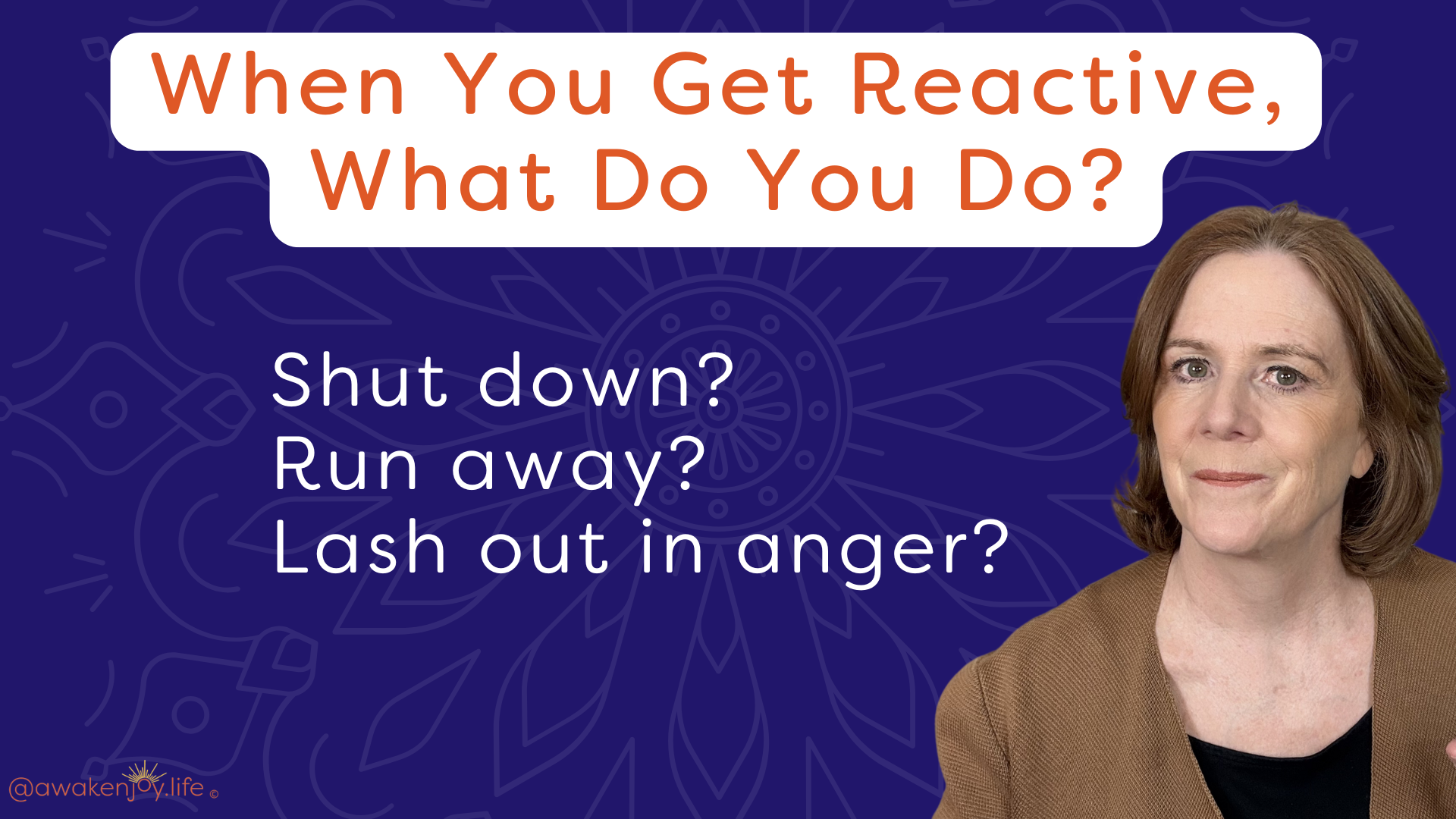
How to Stop Reacting and Start Responding
When you get reactive, what happens? Do you:
- Lash out in anger?
- Automatically say yes when you mean no?
- Shut down in the middle of a conversation
- Run away?
Today's blog explains how calming down reactivity is the most important skill for regulating emotions.
By the end of this article, you'll understand what reactivity is and where yours came from.
By the end of this article, you'll understand what reactivity is and where yours came from.
You'll understand that power lies in the space—the space between an event and our reaction or the space between our emotion and our response. And I'm going to share six strategies for expanding that space, allowing you to choose how to respond instead of defaulting to automatic reactive behavior.
Understanding Reactivity: It's Not Your Personality
Most of us live far more reactively than we realize. We have automatic behaviors that kick in, and we repeat them over and over to the point where we say, "Well, that's who I am. That's my personality." But when you understand the origin of reactivity, you'll probably shift that belief.
Our reactive pattern comes from our fight, flight, and freeze survival mechanism—a primitive survival mechanism.
If we grow up in a dysfunctional family or with significant trauma or stress (including neglect), we develop patterns very young that help us survive. When they become so ingrained that we repeat them over and over later in life, they prove ineffective.
If we grow up in a dysfunctional family or with significant trauma or stress (including neglect), we develop patterns very young that help us survive. When they become so ingrained that we repeat them over and over later in life, they prove ineffective.
For example, if you have a parent who rages, you might learn to freeze or flee. Then later in life, any time there's conflict, you either freeze or flee. A different child in that same family might be the one who fights with the rageful parent. They grow up feeling that in order to survive, they have to fight with that parent, so they become the fighter. Then later in life, whenever there's conflict or stress, they fight.
The Four Reactive Patterns
There are four reactive patterns. Three are the ones mentioned above that you are probably familiar with: fight, flight, and freeze.
The fourth is the fawn response, which is when someone immediately engages in people-pleasing behavior or diminishes themselves to accommodate another. This response also comes from trauma. Someone who fawns automatically moves into a position of appeasing the other. As a child, this might have been necessary for survival, and then it becomes deeply ingrained—so ingrained it feels like part of your personality. Later in life you find yourself doing it constantly, even when it's unnecessary.
The fourth is the fawn response, which is when someone immediately engages in people-pleasing behavior or diminishes themselves to accommodate another. This response also comes from trauma. Someone who fawns automatically moves into a position of appeasing the other. As a child, this might have been necessary for survival, and then it becomes deeply ingrained—so ingrained it feels like part of your personality. Later in life you find yourself doing it constantly, even when it's unnecessary.
The Costs of Chronic Reactivity
Chronic reactivity comes with serious costs:
1. You often feel out of control and ashamed. You know that these reactions don't lead to the outcome you want. This brings up significant shame and guilt.
2. Reactivity causes damage to relationships. If you're a fighter, this is obvious. But it damages relationships if you're a fleer as well. If you're a freezer, people often feel shut out. If you fawn, people feel like they don't know where you stand and can't be close to you. All four reactive patterns impact our relationships.
3. You aren't making decisions aligned with your values and long-term goals.
4. You're reinforcing the neural pathways each time you engage in these behaviors.
The Power of the Space Between The Event and The Response
One of the greatest quotes on this topic comes from Viktor Frankl:
"Between stimulus and response, there is a space. In that space is our power to choose our response. In our response lies our growth and our freedom."
"Between stimulus and response, there is a space. In that space is our power to choose our response. In our response lies our growth and our freedom."
Viktor Frankl was a psychiatrist and neurologist who survived the Nazi concentration camps. He wrote an incredible book I highly recommend called Man's Search for Meaning. He founded a school of thought within psychology and psychiatry based on the premise that man's search for meaning is the most powerful motivational force in our lives.
You are not your automatic reactions.
You have the capacity to choose.
We're going to talk about strengthening that capacity to choose and expanding your ability to access that space between the stimulus and the response.
Six Strategies for Expanding the Space
Strategy #1: Awareness of your habitual pattern and awareness of when you initially get triggered.
Know what situations, people, or emotional events trigger your reactivity. Learn to recognize the signs.
Some signs could be physical: your face getting hot or your pulse rate increasing.
Some might be behavioral: you might have a nervous habit or something you say when you are nervous that you don't mean.
Some signs might be cognitive: your mind goes blank if you're a freezer.
Some signs might be cognitive: your mind goes blank if you're a freezer.
The quicker you recognize the signs, the quicker you can adjust and slow your reactivity.
One exercise to expond your awareness is to keep a journal for a week or two. Note at the end of each day: Did I get reactive today? What was the situation? What did I do? When did I realize I was being reactive? As you pay attention and think it through, I guarantee your awareness will begin earlier and earlier.
Strategy #2: Stop, Take Five, and Think
The second you realize that something reactive is happening within you: Stop, take five deep breaths and think.
You don't have to respond right away. You don't have to answer someone immediately. If you're a fleer, you don't have to run away right away. Stay grounded, take five.
That "take five" can vary. Sometimes it's just five breaths in the moment. Sometimes you might need five minutes. With bigger issues, you might need five hours—you might need time to process what's going on.
Strategy #3: Reset Your Physiology
Regularly practice the things that help you calm your physiology in the moment.
I guarantee that when you get reactive, your pulse rate jumps, your breathing becomes more shallow, and your muscles become more tense. You may or may not be aware of those different physical signals, but as you think this through, you'll become more aware.
The best tools for physiologically relaxing are grounding tools and diaphragmatic breathing tools. You take them everywhere you go, they're free and they're accessible. However, you need to practice them when you're not reactive in order to be able to access them when you are.
I often recommend people practice one of these tools (whichever one is easier or more accessible) for minutes at a time, a few times a day. This gives you greater ability to access that tool when you are activated.
There are other tools that work for people: playing with your pet, taking them for a walk, being out in nature. Those things may not always be accessible, so it's good to have the other tools as well. Know what tools work for you.
Strategy #4: Mindfulness and Meditation
I know these are hard for many people, but these are the tools that will give you the greatest ability to pause—to access that space between something upsetting and your response.
I talk more about this in a free webinar I have called Rewire Your Brain for Joy and Confidence. It's about an hour and 15 minutes and definitely worth it. I hear from many people that they learn a tremendous amount. It's about rewiring the neural pathways that have developed over a long period of time and lead to your reactive behavior.
Strategy #5: Cognitive Reappraisal
This is about thinking about the situation differently. This is not an early step in this process because with reactivity, you must first access some physiological calming so your amygdala calms down. This enables you to bring your frontal lobe online, so you can begin to think about the situation and have the capacity to change how you are thinking about it.
This is a much bigger topic than I can address fully today, but I have several videos and blogs on cognitive distortions, and this blog also discusses it: Skills for Emotional Regulation.
Example 1: Let's say you are highly sensitive to criticism and you become very reactive when criticized. When your boss criticizes you, your brain might jump into "I could lose my job" or "I hate my boss, but I'm trapped and can't get out of this." At the same time, your body is reacting as if you're in physical danger.
There are several different ways of seeing the situation that are probably more accurate:
• Your boss is kind of a jerk. He doesn't deliver criticism well, and it impacts everyone. It is unpleasant, but you are not in physical danger, and the catastrophizing is not needed. If you want to find a different boss and a different job, you can calm down and plan accordingly.
• Or let's say your boss is generally reasonable and you know you are overreacting. You can reassure yourself that you're not in physical danger, and reassure yourself that it is ok to make mistakes. Everybody makes mistakes, which is true. Bosses usually offer criticism because they care about the employee and want to help them improve. If you look at it as a tool for learning—with a feeling of "I'm ok as I am, I just need to learn some things differently" you will be able to calm down and take productive action.
Example 2: A friend doesn't text you back and you immediately get worried you might have done something wrong. You review your last conversations, going over and over them. Your thoughts escalate about how made the person is, or that they will disappear. If you are able to identify that this way of thinking is a habitual pattern from your past, you can stand back from your reactivity and assess it. Bringing in cognitive reappraisal and recognizing the pattern, will help you shift your thinking to, "She's probably just busy. I can try her again tomorrow."
Strategy #6: Value-Based Decision Making
Once you've calmed down and created space, you can think through what response to the difficult situation best reflects your values and your goals in life.
Ask yourself:
• What response would be most aligned with my values and my long-term goals?
• What response helps achieve what I want to achieve?
• What response will make me feel good about my handling of the situation no matter what the outcome is?
Knowing our values is a North Star for us. It relates to the concept that the search for meaning is vital.
In the Roadmap program I have (Roadmap to Joy and Authentic Confidence), the first module is on identifying your values. Which ones do are truly yours versus the ones you were told to have by family or society? What are the most important ones?
This self-exploration helps guide your decisions throughout life.
This self-exploration helps guide your decisions throughout life.
Remember to Practice the Tools and Have Self-Compassion, and Freedom
Practice makes progress—all of this takes practice and time.
Have self-compassion. Know where your reactivity came from and that it made sense to develop this pattern.
The freedom is in the response you choose, not in the automatic reaction.
You can still feel anger, and yet not act out in anger. You can feel anger, and choose
your response.
You can still get your feelings hurt, and yet not act out with your habitual pattern.
All of us will have our feelings hurt, something will make us angry, things will happen that make us sad. All of this is going to happen.
All of us will have our feelings hurt, something will make us angry, things will happen that make us sad. All of this is going to happen.
I know it can be very tempting to listen to those people who say, "If you do everything right, life is perfect." But that simply isn't true.
Knowing your emotions, knowing yourself, and being able to choose your response—that's a wonderful thing.
If you found value in this blog, please share it with someone else you might benefit!
I appreciate you, and I'll see you next week.
I appreciate you, and I'll see you next week.
Blog Author: Barbara Heffernan, LCSW, MBA. Barbara is a licensed psychotherapist and specialist in anxiety, trauma, and healthy boundaries. She had a private practice in Connecticut for twenty years before starting her popular YouTube channel designed to help people around the world live a more joyful life. Barbara has a BA from Yale University, an MBA from Columbia University and an MSW from SCSU. More info on Barbara can be found on her bio page.
Share this with someone who can benefit from this blog!
Anxiety and insomnia often go hand in hand. But is anxiety the only cause of your insomnia? Being screened by a medical doctor is very important. This post reviews the five major areas of medical issues that impact insomnia and also provides a checklist of what to bring to your doctor appointment.

Many people think insomnia is diagnosed based on how many hours you sleep. But it is not. Here's the actual criteria for diagnosis.
Do you worry about how much sleep you get? We have been told for years that we need eight hours of sleep every night — that if we get it, great, and if we do not, it is a major problem. Yet, worrying about this is making the problem worse! Insomnia is painful, and this post includes practical tips to help.
Struggling with anxiety and avoidance? Learn why avoiding uncomfortable situations reinforces fear, causes anxiety to spread, and how exposure therapy, fear extinction, and EMDR can help break the cycle.

Anticipatory anxiety shuts down our creative problem-solving, just when we need it the most. Here's the process to get it back. 4 steps to help anticipatory anxiety.
"Just stop thinking about it" doesn't work. However, the Attention Training Technique from Metacognitive Therapy has been shown to help lower anxiety and rumination.
Does your brain drive you nuts going over and over the same thing—the mistake you made, the difficult conversation you had....anything you are worried about? This is rumination and it is driven by the Default Mode Network of the brain. Understanding this can help you change.
Social anxiety often has a trauma root — understanding the connection can help you heal.
Overloaded and Overwhelmed? You are in the right place. Here's help.

overwhelm has a cruel side effect. It shuts us down. Right when we feel like we need to get more done, not less, overwhelm makes our mind go blank or puts us into a freeze stateUnderstanding how overwhelm manifests for you can really help you calm it down.
